
Bombs Over Diplomacy
Why the US and Israel Chose War Over Peace With Iran, And Who It Really Serves

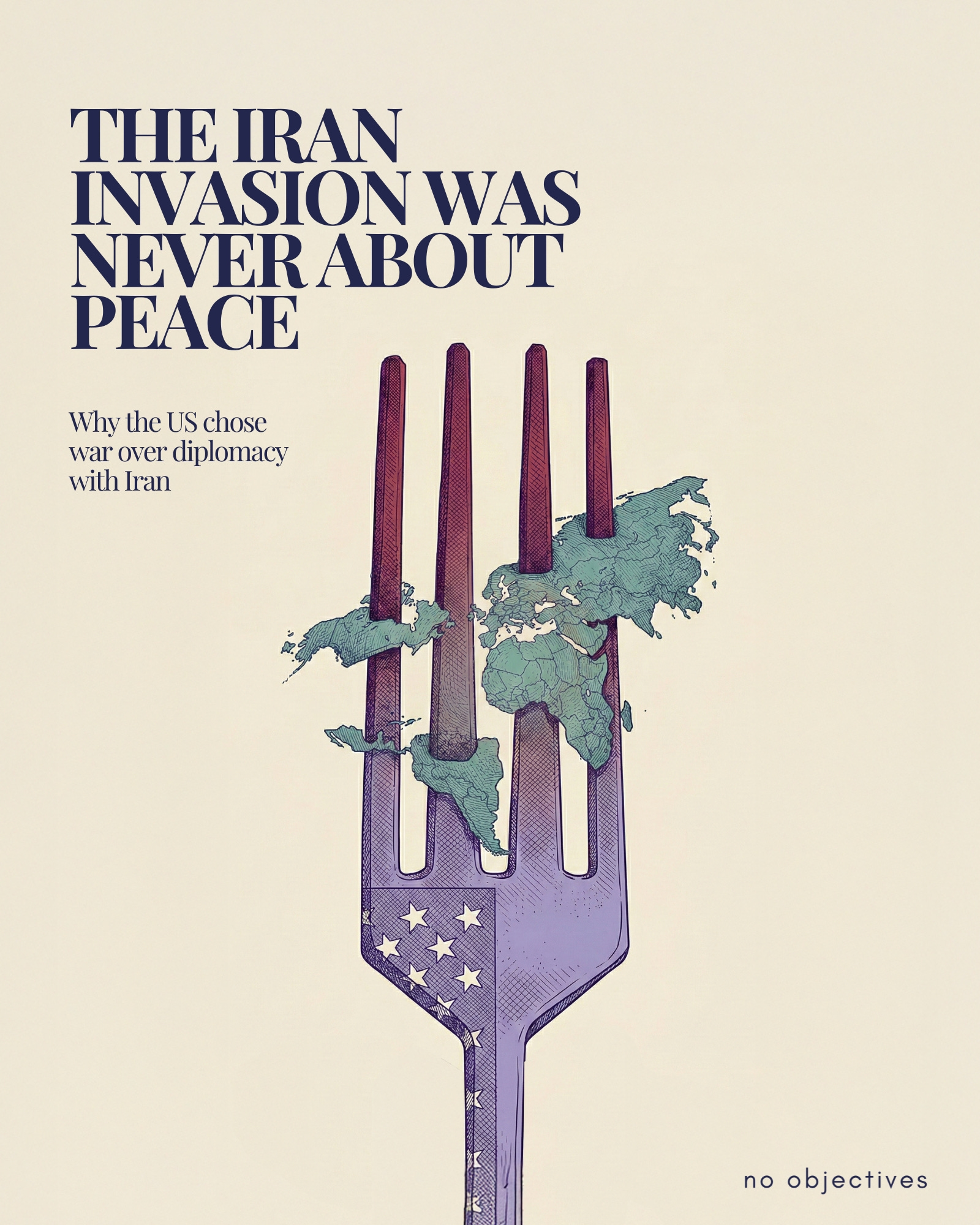
An In-Depth Analytical Essay | March 2026
A Deal Bombed Into Silence
On the morning of February 28, 2026, Oman’s Foreign Minister Badr Albusaidi delivered what should have been one of the most consequential diplomatic announcements in a generation. After months of painstaking indirect mediation between Washington and Tehran, Iran had formally agreed to never stockpile enriched uranium capable of producing a nuclear weapon — the very “zero stockpiling” commitment that Western powers had demanded for years. “The single most important achievement, I believe,” Albusaidi declared, “is the agreement that Iran will never, ever have nuclear material that will create a bomb.” Peace, he said, was “within our reach.”
Within hours, the United States and Israel launched one of the most devastating coordinated military assaults the Middle East had seen in decades. Hundreds of targets across Iran were struck simultaneously. Approximately 40 Iranian officials were killed. The deal was not just rejected, it was erased in fire.
This essay does not ask whether the attack was militarily effective. It asks the question that the bombs were designed to prevent anyone from asking too loudly: Who benefited from the destruction of this peace? And why, at the exact moment diplomacy succeeded, did two governments choose war?
The answers lie not in the deserts of Tehran, but in the courtrooms of Jerusalem and New York, in the bond markets of Hong Kong, and in the oil fields of Venezuela.
Netanyahu’s New War: After Genocide, He Needed a Fresh Battlefield
To understand Benjamin Netanyahu’s desperate hunger for a new conflict, one must reckon with what he was escaping. By late 2025, the Gaza operation had achieved what critics around the world, and an increasing number of international legal bodies, were openly calling a genocide. In September 2025, the world’s leading genocide scholars formally declared that Israel had committed genocide in Gaza. The UN Human Rights Council’s Commission of Inquiry followed, issuing a report titled “Gaza Genocide: A Collective Crime,” recommending that the ICC amend Netanyahu’s existing arrest warrants to explicitly include the crime of genocide. The International Criminal Court, which had already issued an arrest warrant against Netanyahu in November 2024 for war crimes, including the use of starvation as a weapon of war, was moving steadily toward a broader reckoning.
Gaza, in short, was becoming a liability rather than a political asset. The “mowing the lawn” strategy, periodic military assaults to suppress Palestinian resistance, had metastasized into something the international community could no longer look away from. With Gaza’s population decimated and its infrastructure demolished, Netanyahu had run out of runway on that front. The political utility of war is only renewable if the war keeps going. A concluded genocide is just evidence.
Compounding this was his domestic legal catastrophe. Netanyahu faces three separate criminal cases filed in 2019, charges of bribery, fraud, and breach of trust, making him the only sitting Israeli prime minister in history to stand trial. A conviction on bribery alone carries up to ten years in prison. In November 2025, clearly sensing the walls closing in, he formally petitioned Israel’s president for a pardon, arguing that the corruption proceedings were “hindering his ability to govern” a breathtaking claim that he was too busy governing to face accountability for his crimes.
The pardon was not immediately granted. The ICC warrant was not going away. The genocide charges were being assembled. Netanyahu needed a new war, not for Israel’s security, but for his own political survival. Iran, with its convenient status as a designated enemy, provided the perfect alibi. CGTN analysts noted precisely this dynamic: Israel’s strategy has been to force US military entrapment, a pattern visible in June 2025 when Israeli strikes sabotaged US-Iran talks that had been progressing toward agreement, and again on February 28, 2026, when Israeli bombs fell the same day Oman announced the deal’s near-completion. This is not a coincidence. This is statecraft deployed as personal legal defense.
Trump’s Burning Platform: Epstein, Indictments, and a Collapsing Base
On the other side of this alliance stands Donald Trump, a man governing from inside a legal and political siege unlike anything in American presidential history. Trump entered his second term having been convicted on 34 felony counts of falsifying business records, with 88 total criminal charges across four indictments still haunting his administration. While he received an “unconditional discharge” at sentencing, a remarkable act of judicial restraint that his enemies called impunity and his allies called vindication, the convictions stand, the appeals are ongoing, and the political weight is real. But it is the Epstein files that have done something no prosecutor managed to do: crack his own base. For years, Trump’s MAGA coalition was animated by a core conspiracy belief, that a secret elite pedophile ring was running the world, that the “deep state” was protecting child traffickers, and that Trump alone would expose it. The Jeffrey Epstein case was their central exhibit. When Trump took office, his most fervent supporters expected fireworks.
What they got instead was a soggy sparkler. Trump initially blocked the release of the Epstein files, prompting an internal MAGA civil war of remarkable ferocity. Emails surfaced suggesting Trump “knew about” Epstein’s activities. Marjorie Taylor Greene, one of Trump’s most loyal congressional allies, called his handling of the files a “punch in the gut” and was branded a “traitor” by the Trump operation for demanding their release. Young conservative voters described feeling “betrayed” and “not able to trust” the president they had elevated as their champion against elite corruption. As Vox noted plainly: Trump had “betrayed a fundamental structure of his political movement.” The polling reflected the damage. By the time the Iran strikes were launched, Trump’s overall approval rating had sunk to between 37% and 41%, the lowest of his term. His foreign-policy approval sat at just 35%. As the New York Times noted pointedly, by attacking Iran, Trump was “telling the world he’s not America First”, the very brand he had sold his voters for a decade. Foreign Policy magazine ran a piece titled simply: “Trump Is Betraying His Base By Waging War on Iran.”
A war, however unpopular in the abstract, is a political reset button. It changes the news cycle. It wraps the president in the flag. It makes critics look unpatriotic. It transforms a convicted felon scrambling to survive Epstein scandals and polling collapses into a commander-in-chief making “tough decisions.” The authoritarian playbook does not require subtlety. It only requires that the bombs fall loudly enough to drown out everything else.
The BRICS Revolution and the Petrodollar’s Death Rattle
But behind the personal crises of two cornered leaders lies a structural crisis far more consequential: the slow-motion collapse of the dollar’s global supremacy, and Iran’s central role in that collapse. To grasp what is truly at stake, one must revisit what former French Finance Minister Valéry Giscard d’Estaing called America’s “exorbitant privilege.” Since the 1973 petrodollar arrangement, when Henry Kissinger secured Saudi Arabia’s agreement to price all oil exclusively in dollars , the United States has enjoyed an almost supernatural economic power. When the world must buy dollars to purchase oil, American deficits are effectively subsidized by every nation on earth. The Congressional Research Service estimates this saves the US government between $100–250 billion annually in borrowing costs. More crucially, it makes the dollar into a weapon: control dollar access, and you control the global economy. That architecture is now fracturing at an accelerating pace.
In November 2025, China issued $4 billion in US dollar-denominated bonds in Hong Kong. The orders that came in totaled $118 billion, thirty times oversubscribed. Global investors were accepting lower yields on Chinese debt than on American Treasury bonds, despite China holding a lower credit rating. As my previous article on the US invasion into Venezuela argued> this was a challenger brand outselling Coca-Cola at a higher price. It simply doesn’t happen. Until it did. This was not fundraising, China has over $3 trillion in foreign exchange reserves. It was a demonstration. A proof of concept. A message to the world that an alternative to the dollar system is not a future aspiration but a present reality.
The BRICS bloc, now representing 45% of the world’s population, 35% of global GDP, and 30% of global oil production, has been methodically building the infrastructure to make dollar dependence optional. China’s Cross-Border Interbank Payment System (CIPS) processed an average of 9.6 trillion yuan daily in 2024, representing 65% year-over-year growth, connecting over 1,700 financial institutions across 180 countries. The New Development Bank has issued over $32 billion in loans, increasingly denominated in local currencies. By end 2024, 90% of Russia’s trade with BRICS partners was settled in national currencies, not dollars. And central banks are voting with their vaults: emerging market central banks accumulated 634 tonnes of gold in just the first nine months of 2025, a pace not seen since the 1960s. When central banks abandon dollar reserves for gold at this velocity, they are preparing for a world where the dollar is one option among many, not the only option that matters.
Iran: Not Just a Nuclear Threat, A Financial One
This is where Iran’s true transgression becomes clear, and why a diplomatic deal was never acceptable to Washington and Tel Aviv, regardless of what Iran agreed to.
Iran joined BRICS in 2024. Since 2012, Iran has been selling oil in currencies other than the dollar. China’s oil trade with Iran has been settled primarily in renminbi. Beijing and Tehran operate under a 25-year cooperation agreement, signed in 2021, that secures discounted Iranian oil for China in exchange for Chinese infrastructure investment. Iran has been systematically integrating itself into the alternative financial architecture that BRICS is constructing, an architecture explicitly designed to reduce dollar dependency. This is the pattern that triggers American military response, and it has nothing to do with nuclear weapons. Iraq’s Saddam Hussein announced in 2000 that he would accept only euros for Iraqi oil. He was removed from power three years later. Libya’s Muammar Gaddafi proposed a gold-backed pan-African currency to replace the dollar for oil transactions. NATO intervened in 2011. Iran began selling oil in non-dollar currencies in 2012 and has faced continuous sanctions, pressure and repeated threats of military action ever since.
The pattern is unmistakable, and The Guardian noted it plainly in the wake of the February 2026 strikes: “Trump’s Iran strikes accelerate the world’s drift from dollar dominance.” The trade-weighted dollar had already lost 7% of its value over the preceding year. The bombs fell not just on Iranian territory, but on the credibility of American financial coercion — because every nation watching this unfold now knows that even agreeing to zero nuclear stockpiling is not enough to earn peace if you are threatening the dollar system.
As The Wire put it with surgical clarity: “The US and the Western world carried out the appearance of dialogue with Iran, when the aim was always to enforce regime change.” Diplomacy was the stage set. The military option was always the plan.
Venezuela, Cuba, Iran: Empire’s Pattern of Violence
None of this can be understood in isolation. Iran is the latest chapter in a long, blood-soaked book that also includes Cuba and Venezuela. In Cuba, the United States has maintained a punishing economic embargo for over sixty years with the explicit stated goal of toppling its government, one of the longest sustained economic warfare campaigns in modern history. The embargo is not about human rights. Cuba is no more authoritarian than dozens of U.S. allies. It is about the refusal to submit.
And the pressure has not stopped. In 2026, the United States escalated its campaign by declaring a national emergency with respect to Cuba and introducing new extraterritorial sanctions designed to cut off the island’s oil supply, threatening tariffs on any country that trades fuel with Havana. These measures, combined with the seizure of oil shipments in the Caribbean and wider operations targeting Venezuela’s exports, have contributed to a severe energy and humanitarian crisis on the island, with widespread blackouts, shortages of food and medicine, and growing international criticism of what many describe as a de facto fuel blockade.Effectively killing innocent Cubans, in order for the US to gain control.
In Venezuela, which possesses the world’s largest proven oil reserves, 303 billion barrels, exceeding even Saudi Arabia’s 298 billion, the Trump administration mobilized for military intervention just one month after China’s November 2025 Hong Kong bond proved the viability of dollar alternatives. Venezuela had been selling 100% of its oil exports to China in yuan since 2018. It joined BRICS+ in 2024. It became a living, breathing advertisement that the dollar system is optional, not mandatory. That made it a target. As often our analysis should conclude: “Follow the money. Follow the oil. Follow the currency used to price that oil.” Cuba’s UN delegate captured the logic exactly when he warned the Security Council that US “hegemonic and criminal plans” toward Venezuela had “already produced serious and predictable consequences.” The Monroe Doctrine, which for two centuries has asserted American dominance over the Western Hemisphere, has never been about democracy. It has always been about ownership. With Venezuela destabilized, Cuba starved by sanctions, and Iran now bombed into chaos, the message Washington sends to every nation in the Global South is identical: Build an alternative to our financial system, and we will destroy you. Negotiate on your own terms, and we will bomb those terms into ash.
The Multipolar World They Are Bombing Into Existence, Or Trying to Stop
Here is the supreme irony: the United States is accelerating the very thing it is trying to prevent. The Guardian observed that Trump’s Iran strikes were actively accelerating the world’s drift from dollar dominance. Every bomb dropped on a country that dared to trade outside the dollar system is also a bomb dropped on the credibility of the dollar as a neutral, stable medium of global exchange. Every act of economic coercion, every SWIFT disconnection, every frozen reserve, every sanctions regime, teaches the remaining nations of the world a lesson: hold dollars, and you hold a weapon that can be turned on you at any moment. Brazil already conducts 25–30% of its China trade in local currencies. Argentina repays IMF debts in renminbi. ASEAN businesses, per a 2025 Bank of China survey, now prefer RMB financing at a rate of 77%. The New Development Bank is expanding. CIPS is growing at 65% annually. The BRICS payment system is advancing. This multipolar financial architecture is not a future threat to American hegemony. It is the present reality, and the bombs are making it more attractive, not less. As historian Alfred McCoy has observed, empires rarely see their own extinction coming. The British Empire fought to maintain pound sterling dominance and lost anyway. The transition was neither smooth nor peaceful. The difference today is that nuclear weapons, interconnected supply chains, and instantaneous digital financial contagion mean that the cost of resisting the inevitable has become civilization-threatening.
The Architecture of the Lie
On February 28, 2026, everything the official narrative requires you to believe collapsed simultaneously. Iran had agreed to zero nuclear stockpiling. Oman had confirmed it publicly. A deal was documented and announced. And within hours, bombs fell.
They fell because Netanyahu needed a new war to escape genocide charges and a corruption trial that could send him to prison for a decade. They fell because Trump needed a distraction from Epstein, from his 34 felony convictions, from an approval rating in free-fall, from a base that felt genuinely betrayed. They fell because the United States cannot tolerate an Iran that trades oil in yuan, participates in BRICS, and demonstrates to the world that the dollar system is voluntary. They fell because the petrodollar — the financial architecture that has funded American power since 1973 — is crumbling, and the empire’s immune system is responding with the only tool it has ever truly trusted: violence.
Venezuela was the opening move in this game. Cuba was the decades-long rehearsal. Iran is where the stakes have been raised to civilizational proportions. The question is not whether the multipolar world is coming — the bond markets, the gold reserves, the yuan-denominated trades, and the oversubscribed Chinese bonds have already answered that. The question is how much of the world will burn while two criminally accused men try to use it as cover.
The deal was real. The bombs were personal. And history will remember both.
Sources
“Peace ‘within reach’ as Iran agrees no nuclear material stockpile: Oman FM” — Al Jazeera — https://www.aljazeera.com/news/2026/2/28/peace-within-reach-as-iran-agrees-no-nuclear-material-stockpile-oman-fm
“Iran agreed to ‘zero stockpiling’ of nuclear material in US talks” — The Hill — https://thehill.com/policy/international/5759623-iran-nuclear-deal-stockpiling/
“Oman Says US-Iran Talks Reach Agreement On ‘Zero Stockpiling’” — Bernama — https://www.bernama.com/en/world/news.php?id=2528676
“Live Updates: U.S.-Israel launch another round of strikes on Iran” — CBS News — https://www.cbsnews.com/live-updates/israel-us-attack-iran-trump-says-major-combat-operations/
“US, Israel bomb Iran: A timeline of talks and threats leading up to attacks” — Al Jazeera — https://www.aljazeera.com/news/2026/2/28/us-israel-bomb-iran-a-timeline-of-talks-and-threats-leading-up-to-attacks
“Israel’s strategy is about forcing US entrapment” — CGTN — https://news.cgtn.com/news/2026-03-01/Israel-s-strategy-is-about-forcing-US-entrapment-1L9yi89giyI/p.html
“There Is No Pretext or Plan for the US-Israel War on Iran” — Jacobin — https://jacobin.com/2026/02/iran-war-imperialism-us-israel
“Israel has committed genocide in Gaza, says UN Commission of Inquiry” — The Guardian — https://www.theguardian.com/world/2025/sep/16/israel-committed-genocide-in-gaza-says-un-inquiry
“2025 UNHRC Commission of Inquiry report on Gaza genocide” — Wikipedia/UN — https://en.wikipedia.org/wiki/2025_UNHRC_Commission_of_Inquiry_report_on_Gaza_genocide
“Netanyahu — International Criminal Court” — ICC — https://www.icc-cpi.int/defendant/netanyahu
“Netanyahu seeks pardon in corruption trial” — Reuters — https://www.reuters.com/world/middle-east/netanyahu-officially-asks-israeli-president-pardon-2025-11-30/
“Netanyahu corruption trial” — BBC News — https://www.bbc.com/news/topics/cwgw7z7dvlwt
“Trump becomes first former US president convicted of felony crimes” — AP News — https://apnews.com/article/trump-trial-deliberations-jury-testimony-verdict-85558c6d08efb434d05b694364470aa0
“Donald Trump indictments, 2023–2025” — Ballotpedia — https://ballotpedia.org/Donald_Trump_indictments,_2023-2025
“Epstein Scandal Leaves Some Young Trump Voters Feeling Betrayed” — The New York Times — https://www.nytimes.com/2026/02/20/style/epstein-files-young-conservatives.html
“Why Trump betrayed his base on Jeffrey Epstein” — Vox — https://www.vox.com/on-the-right-newsletter/419784/trump-epstein-maga-rebellion-populism
“Trump Is Betraying His Base By Waging War on Iran” — Foreign Policy — https://foreignpolicy.com/2026/02/28/trump-voter-base-foreign-policy-war-iran/
“Overall presidential approval at 41%, foreign-policy approval at 35%” — The New York Times — https://www.facebook.com/nytimes/posts/from-the-new-york-times-opinion-section-by-attacking-iran-president-trump-is-tel/1310191400963320/
“Trump’s Iran strikes accelerate the world’s drift from dollar dominance” — The Guardian — https://www.theguardian.com/world/2026/mar/01/trump-world-slow-drift-dollar-dominance-iran-strikes-currency
“US-Israeli Attack on Iran Exposes the Bipartisan Face of American Primacy” — The Wire — https://m.thewire.in/article/world/todays-strikes-on-iran-expose-the-bipartisan-face-of-american-primacy-and-may-hasten-its-decline
“US dollar: ‘Wounded hegemon’ or secure as most powerful currency?” — Al Jazeera — https://www.aljazeera.com/news/2026/1/27/us-dollar-wounded-hegemon-or-secure-as-most-powerful-currency-on-earth
“BRICS and the Shift Away from Dollar Dependence” — Chicago Policy Review — https://chicagopolicyreview.org/2025/10/08/brics-and-the-shift-away-from-dollar-dependence/
“What is the petrodollar and why is it under pressure?” — Green Central Banking — https://greencentralbanking.com/2026/01/29/what-is-the-petrodollar-system-and-how-might-green-energy-replace-it/
“Can Multipolar Blocs Offer Iran a Way Out of Isolation?” — Middle East Council — https://mecouncil.org/publication/can-multipolar-blocs-offer-iran-a-way-out-of-isolation/
“CRINK Economic Ties: Uneven Patterns of Collaboration” — CSIS — https://www.csis.org/analysis/crink-economic-ties-uneven-patterns-collaboration
“Making sense of the US military operation in Venezuela” — Brookings Institution — https://www.brookings.edu/articles/making-sense-of-the-us-military-operation-in-venezuela/
“After Venezuela, the United States Could Turn its Attention to Cuba” — The Soufan Center — https://thesoufancenter.org/intelbrief-2026-january-27/
“United States Action in Venezuela Puts Sovereignty of States at Issue” — UN Security Council Press — https://press.un.org/en/2026/sc16271.doc.htm
“Hegemony and Resistance: US Imperial Strategies in Latin America” — Taylor and Francis — https://www.tandfonline.com/doi/full/10.1080/19436149.2025.2578046
“’Empire in Decline’: Historian Alfred McCoy on US Hegemony” — Democracy Now — https://www.democracynow.org/2026/1/13/alfred_mccoy_cold_war_on_five
“The Real Reason Why the US Overthrew Venezuela” —The Real Reason Why the US Overthrew Venezuela
Thank you so much for this brilliant analysis.
This is an excellent article/analysis and will be forwarded out to my own group of friends/family/acquaintances.