
Doing First, Believing Later
How Personal Experience Quietly Builds Support for Climate Policy

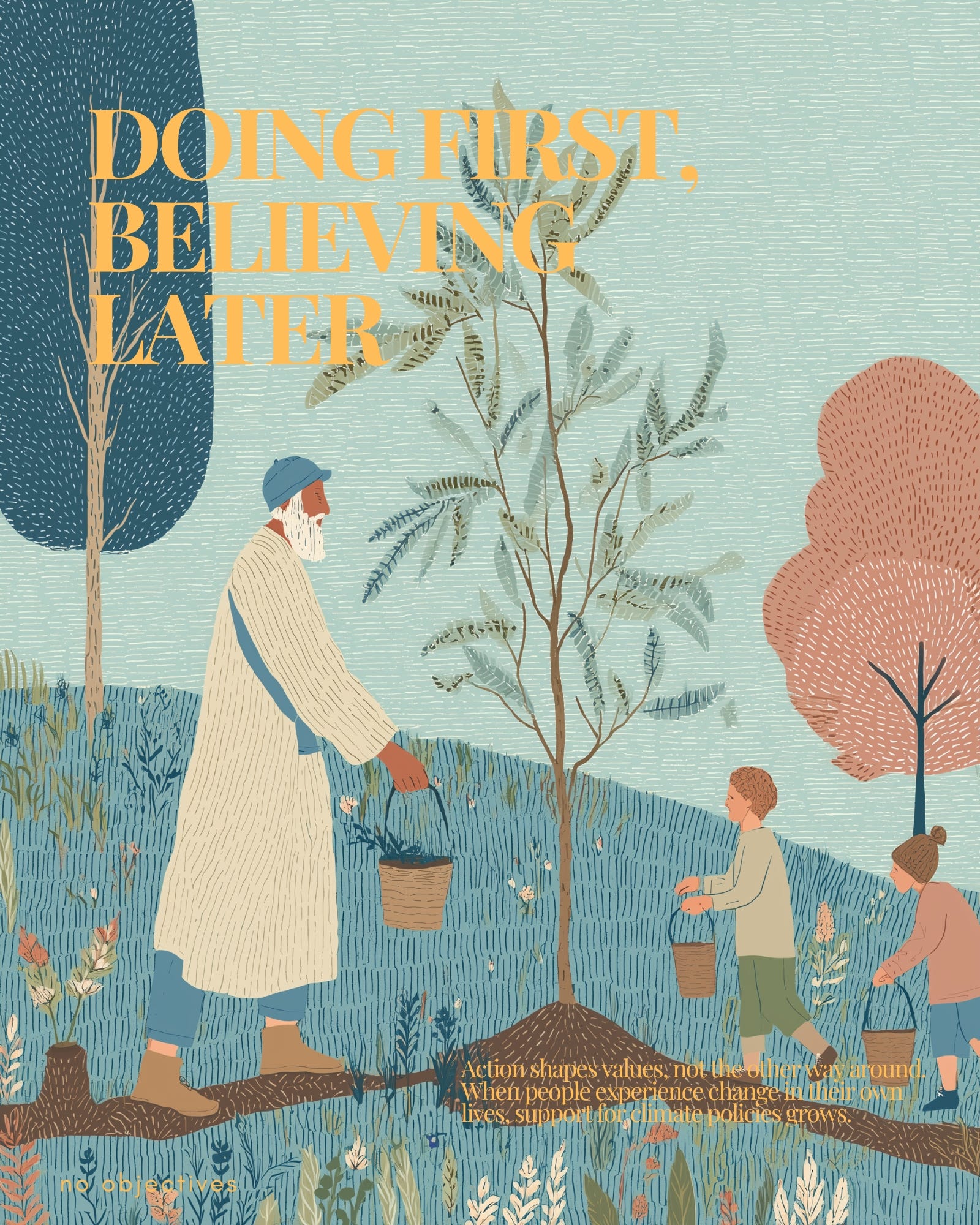
Imagine trying to convince a friend to support a new rule that would make meat more expensive. You could bring charts about emissions, quote reports from the IPCC, and appeal to their moral responsibility. Or you could invite them over for dinner, cook a surprisingly good plant-based meal, and casually mention that you have been eating less meat lately and feel fine about it.
Which approach do you think works better?
For decades, climate politics has been built on the first strategy. The assumption has been simple and intuitive: if people care enough about the environment, they will change their behavior and support strong climate policies. Values come first. Action follows. Policy support is the final step.
New research turns this story on its head. It suggests that, in many cases, we have been getting the order wrong. People do not always act because they hold strong environmental values. Often, they come to support climate policies because they have already acted, or at least because they believe they could act.
In short, doing shapes believing.
This insight might sound subtle, even obvious. But its implications for climate action, democracy, and political strategy are anything but small.
The Puzzle Climate Campaigners Have Long Faced
Climate science has been clear for years. We know what drives emissions. We know which sectors matter most. We know that large-scale policy is essential. Yet public support for ambitious climate policies remains fragile, uneven, and often surprisingly shallow.
This has led to a familiar frustration. If people say they care about climate change, why do they resist policies like meat taxes, flight levies, or carbon pricing? Why does concern fail to translate into political backing when it matters most?
The dominant explanation has focused on attitudes. Maybe people do not care enough. Maybe they do not understand the science. Maybe they are selfish, misinformed, or manipulated by vested interests.
The research behind this essay offers a different diagnosis. It suggests that many people hesitate not because they lack concern, but because they cannot imagine themselves living differently. When a behavior feels impossible, unfair, or out of reach, policies that promote it feel threatening. When a behavior feels doable, policies suddenly seem reasonable.
That shift in perspective changes everything.
What the Researchers Actually Found
The study examined responses from 4,003 people across four countries. Instead of asking only about abstract climate attitudes, the researchers focused on something more concrete: perceived behavioral capability. In plain language, they asked people whether they felt capable of changing specific high-impact behaviors, such as eating less meat, buying an electric vehicle, or flying less.
They then compared these answers with support for matching climate policies. Meat taxes were paired with meat consumption. Electric vehicle subsidies were paired with car purchases. Aviation policies were paired with flying.
The pattern that emerged was striking.
People who felt capable of changing a specific behavior were significantly more likely to support government policies targeting that same behavior. Those who believed they could reduce their meat consumption were more supportive of meat taxes. Those who could imagine themselves buying an electric vehicle were more enthusiastic about subsidies for EVs.
Crucially, this was not just a general pro-environment attitude showing up everywhere. The relationship was domain-matched. Feeling capable of eating less meat did not automatically make someone support unrelated climate policies. The effect was specific, targeted, and robust.
Perhaps most revealing of all, this link was strongest among high-income individuals.
Why the Wealthy Matter So Much
At first glance, the income finding might seem like a technical detail. In reality, it may be the most politically important result in the entire study.
High-income individuals tend to have larger carbon footprints. They fly more, drive more, consume more, and live in larger homes. Globally, the richest 10 percent of people are responsible for roughly half of lifestyle-related emissions. They also wield disproportionate political influence through voting power, donations, professional networks, and agenda-setting roles.
Among these groups, the connection between perceived ability to change and policy support was especially strong. When wealthy individuals felt capable of adopting a climate-friendly behavior, their support for related policies increased markedly.
This creates a powerful opportunity. If personal experience can shift the policy preferences of those with the biggest footprints and the loudest political voices, then enabling behavior change among the wealthy is not just a moral issue. It is a strategic one.
But there is a catch.
The same high-income groups often felt least capable of changing certain behaviors, especially flying. In countries like Denmark and the United States, frequent air travel is deeply embedded in professional status, global work cultures, and social expectations. For many high earners, flying less feels not just inconvenient, but incompatible with how their lives are structured.
This helps explain why aviation policy remains politically radioactive, even though flying is one of the most carbon-intensive personal activities. The people who fly the most are also the people who struggle to imagine flying less, and therefore resist policies that would push them in that direction.
The Psychology Behind the Pattern
Why does perceived ability matter so much? The answer lies in some well-established features of human psychology.
First, there is our deep need for cognitive consistency. We are uncomfortable when our beliefs and behaviors clash. If you see yourself as someone who could eat less meat, it feels inconsistent to oppose policies that encourage exactly that. Supporting the policy helps align your self-image with your political stance.
Second, there is the so-called foot-in-the-door effect. Small commitments change how we see ourselves. Once someone takes a modest climate-related step, or even seriously considers doing so, they are more likely to adopt a broader identity as a person who cares and acts. Supporting policy then becomes a natural extension of that identity.
Third, there is experiential learning. Climate change is abstract, global, and slow-moving. Personal experience is concrete and immediate. Cooking plant-based meals, trying public transport, or test-driving an electric car turns climate action from a distant moral demand into a lived reality. Policies stop feeling like ideological impositions and start feeling like practical support.
Finally, there is self-persuasion. People are more convinced by arguments they generate themselves than by arguments imposed from the outside. When someone voluntarily adjusts their behavior, they also create their own internal reasons for why that change makes sense. Those reasons are surprisingly durable.
Together, these mechanisms explain why action does not just follow values. It actively reshapes them.
Why This Changes the Climate Debate
This research challenges a familiar and unproductive divide in climate discussions: individual action versus systemic change.
Individual actions are often dismissed as distractions, moralizing gestures, or drops in the ocean. Systemic change, by contrast, is treated as the only thing that really matters. While it is true that policy and infrastructure drive the bulk of emissions reductions, the psychological role of individual action has been badly misunderstood.
Personal behavior change is not primarily important because of the emissions it saves directly. It is important because it builds the mental and emotional groundwork for political support.
Seen this way, encouraging individual action is not a substitute for policy. It is preparation for it.
Designing Smarter Pathways to Change
If action shapes values, then climate strategy should focus less on preaching and more on enabling experience.
The first priority is accessibility. People need opportunities to try climate-friendly behaviors without excessive risk, cost, or hassle. Free public transport days, plant-based meals in canteens, and electric vehicle test programs all lower the threshold for experimentation. Once people experience a change, perceived capability rises.
The second priority is sequencing. Not all behaviors are equally ready for policy intervention. The research suggests that reducing red meat consumption and adopting electric vehicles already feel relatively feasible to many people. These areas are fertile ground for early policy wins. Success here can build confidence, political coalitions, and a sense that change is possible.
The third priority is equity. Lower-income participants showed a weaker link between perceived capability and policy support, likely because constraints are real. If a behavior feels financially or practically impossible, policies that promote it feel unfair. Climate policies must therefore embed affordability, alternatives, and social protection from the start.
Finally, there is the importance of making the political link explicit. Individual action should not be framed as a private moral duty, but as part of a collective journey. Trying a new behavior can be paired with advocacy, storytelling, and shared reflection. Doing and demanding can reinforce each other.
A New View of Democratic Change
Perhaps the most profound implication of this research is what it says about democracy itself.
We often assume that public opinion is fixed, and that politicians must wait for majority support before acting. This study suggests a more dynamic picture. Preferences are not just inputs to policy. They are shaped by lived experience, which policy can actively create.
Well-designed policies that enable new behaviors can generate their own support base over time. Infrastructure changes habits. Habits change values. Values change politics.
This is not manipulation. It is an honest recognition that people learn what they believe through what they live.
Ending Where We Should Have Started
Climate action does not begin in the voting booth or the policy argument. It begins in kitchens, garages, streets, and daily routines. Not because individual choices will save the planet on their own, but because they quietly reshape what people find reasonable, fair, and worth supporting.
The research tells us something both sobering and hopeful. We do not need to wait for everyone to hold perfect climate values before acting. We need to create conditions that let people experience change for themselves.
When people do, belief follows. And belief, once rooted in experience, is far more powerful than persuasion alone.
Reference:
Nielsen, K. S., Dablander, F., Debnath, R., Emogor, C. A., Ghai, S., Gwozdz, W., Hahnel, U. J. J., Hofmann, W., & Bauer, J. M. (2026). Perceived plasticity of climate-relevant behaviors and policy support among high- and lower-income individuals. Global Environmental Change, 96, 103107. https://doi.org/10.1016/j.gloenvcha.2025.103107
"Climate action does not begin in the voting booth or the policy argument. It begins in kitchens, garages, streets, and daily routines."
That is why I am a social scientist.
This post really resonated with my own experience of how I became a vegetarian. It’s true that it all started with my daughter’s master’s thesis; she had earned a master’s degree in Human Values and Ethics in the World. The topic she chose was the responsibility of scientists regarding animal mistreatment on farms. She was the first one to make us aware of animal suffering. I started eating much less meat, but I truly became a vegetarian when my partner began cooking delicious recipes from a vegan Persian cookbook that a roommate had given us. Then came an unexpected bonus: our digestion and overall health have been excellent ever since. And of course the satisfaction of doing the right thing for the environment.