
How We Forgot to Stay
How we are not actually lonely but starved for belonging.

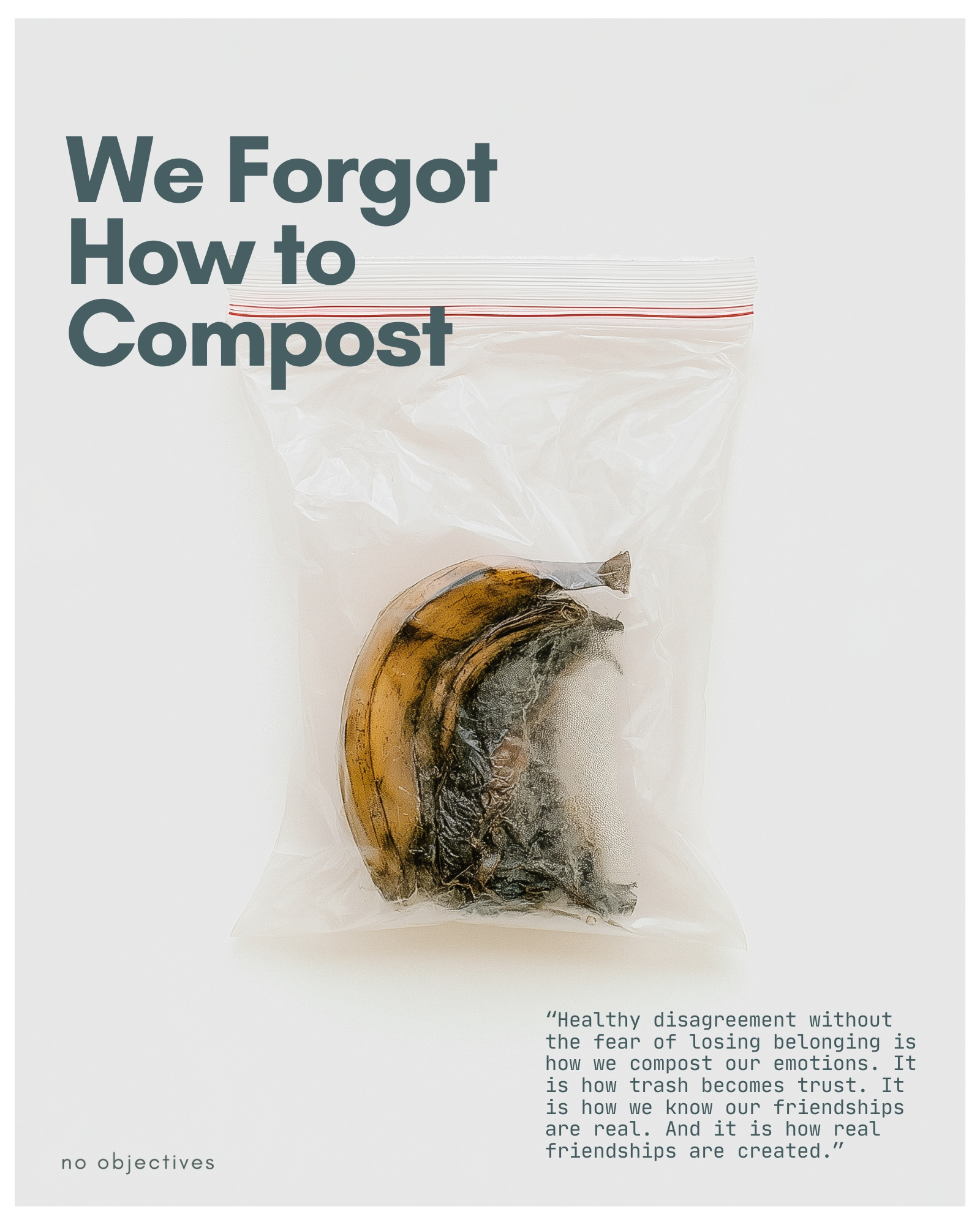
Put a banana peel in a compost heap and within six weeks it becomes soil. Put the same peel in a sealed plastic bag and it becomes garbage that will outlive your grandchildren. It’s the same peel and it’s the same rot. The only thing that changed is whether it was made to stay put long enough to turn into something.
Conflict behaves exactly the same way, disagreement is organic matter. Kept in a closed system, among people who cannot easily walk away from you, it breaks down into something that feeds the relationship. This is the actual machinery of belonging. Healthy disagreement, the kind that never once threatens your place in the group, is how we compost our emotions. It is how trash becomes trust. It is how a friendship proves to you that it is real, and it is how nearly every real friendship gets built in the first place. Left in the open, among people who can leave the moment it gets warm, the same disagreement just rots in the air and stinks, and everyone backs away from the smell. We have built an entire civilization that is brilliant at the second thing and has almost completely forgotten how to do the first.
Consider sport, which is the landfill option for human emotion. Sport is wonderful precisely because it asks nothing of you afterward. It hands you permission to shout, to take a side, to despise strangers in the wrong colored shirt, to carry ninety minutes of pure tribal feeling and then set it down. You leave the stadium lighter. You have released something real. You have also resolved nothing, repaired nothing, and risked nothing with anyone whose opinion of you matters. That is not a flaw in sport. That is the entire product. Catharsis is throwing the rot away. It feels like cleansing because it is cleansing, in the way that emptying a bin is cleansing. Nothing was transformed. It was just removed.
The trouble starts when a society runs out of places to do the other thing. The standard diagnosis for why everyone feels unmoored right now is loneliness. We point at the phones, at individualism, at the slow evaporation of the people who used to be around. The patron saint of this story is Robert Putnam, whose Bowling Alone documented a collapse so precise it sounds invented: between 1980 and 1993, the total number of Americans who went bowling rose by ten percent, while the number who bowled in organized leagues fell by forty. More people rolling the ball. Almost nobody is doing it with anyone. The same period gutted the membership of nearly every organization that once held a town together. The numbers are not in dispute. The trend is real. People genuinely are more alone.
But the loneliness story has the cause and the symptom in the wrong order. We are, by nearly every raw measure of contact, the most connected people who have ever lived. We also report feeling more alone than any generation on record. Both things are true at once, and they only stop contradicting each other the moment you notice that contact is not belonging. We do not feel alone because there are fewer people around us. We feel alone because there are fewer and fewer people we can be wrong in front of, openly and repeatedly, without losing our place beside them. What we lost was never company. Company is everywhere, on tap, more of it than any human in history has had access to. What we lost was the specific and deeply unglamorous kind of company you cannot quit, the kind sturdy enough to survive a real disagreement. The bowling league was never precious because it was warm. Half the people in it were tedious and one of them was always cheating on the score. It mattered because you were stuck with those same faces every Thursday for years, including the ones you could not stand, and walking away was expensive enough that you mostly didn’t. We talk as though we lost connection. We did not. We lost captivity. The good kind.
To understand why that matters, you need Albert Hirschman. In 1970, Hirschman published a thin book called Exit, Voice, and Loyalty that quietly explained most of what has gone wrong since. His argument is almost embarrassingly simple. When something you belong to starts to deteriorate, your marriage, your party, your local football club, your country, you have two basic responses. You can leave. He called that exit. Or you can stay and make noise and try to fix it from the inside. He called that voice. And then he noticed the mechanism that ruins everything: the two are on a seesaw. The easier it is to exit, the less anyone bothers to use their voice. Why fight to repair a thing you can simply replace? Exit, in Hirschman’s words, undercuts voice.
Voice is the muscle of repair. Voice is composting. It is how belonging survives a disagreement instead of dissolving in one. And we have spent fifty years making exit free, frictionless, and morally heroic. Don’t like your neighbors? Move. School not working? There is a private one. The community feels off, the group has changed, the vibe has soured? Leave, and feel wise for leaving, because we have wrapped exit in the language of self-respect and boundaries and knowing your worth. Every one of those exits is individually rational. Each one is the smart move for the person making it. And collectively, exit by exit, we have raised an entire population fluent in leaving and functionally illiterate in staying. We are very good at finding new people. We have no idea what to do with the ones we already have once they annoy us.
Here is the part that should make you angry rather than nostalgic, because nostalgia is just exit pointed at the past. The third places did not drift away on some gentle tide of screens and apathy. They were sold. A bowling alley occupies twenty to forty thousand square feet of commercial land, and the moment that land was worth more as a parking structure or a logistics depot, the math made the decision and a developer signed it. The soccer clubs, the union halls, the local associations, the cheap rooms where people who had nothing in common were forced to negotiate the heating bill: these were not failed by us. They were liquidated for a better return. And the things that replaced them all charge admission. The boutique gym. The members’ club. The co-working floor. The subscription that bills you monthly until you remember to cancel.
Admission is exit by design. The instant a place costs money to enter, leaving becomes the default and staying becomes the thing you have to justify to yourself every billing cycle. You cannot compost in a room where the meter is running. You will always, eventually, conclude that you are not getting your money’s worth, because that is the only question a paid space teaches you to ask. The genius of the old third place was that it was too cheap and too local to leave cleanly. The genius of the new one is that leaving is one tap in an account settings menu. And nobody composts a disagreement with a person they can unsubscribe from.
Now, the honest objection, and it is a strong one. Cheap exit is freedom. Tell the woman trapped in a violent marriage that she should have stayed and learned to compost. Tell the child rotting in a failing school to develop a more constructive dialogue with the institution starving him. Exit is not a trap we fell into. Exit is a human right, and Hirschman knew it better than anyone: when a person can neither leave nor be heard, that is not community, that is captivity of the bad kind, and the correct word for it is oppression. The ability to walk away from things that are hurting you is one of the genuine moral achievements of the modern world, and I am not going to pretend the bowling league was a utopia worth the cost of locking anyone inside it.
All of that is true. None of it touches the actual problem. The problem is not that exit exists. The problem is that a society which makes exit the answer to everything slowly forgets that some containers cannot be left. You cannot exit your country each time it disappoints you. You cannot switch to a better electorate or cancel your fellow citizens. You are stuck, permanently, with roughly eighty million people who voted against everything you believe, and they are stuck with you, and neither side gets to empty the bin. Democracy is the one compost heap nobody is allowed to leave.
Which is the whole catastrophe in a sentence. We spent half a century dismantling every low-stakes place where ordinary people practiced the unglamorous art of staying in a room with someone they could not stand and not setting the room on fire. The bowling league. The parish. The residents’ association where you loathed the chairman but showed up anyway because someone had to deal with the drains. Those were the training grounds. They were where you learned, through tedious repetition, that disagreement does not have to mean someone leaves, that you can think a person is wrong on Tuesday and still need them on Friday, that belonging does not require agreement. We sold the gyms and kept the muscle they built on a shelf, assuming it would last. It did not last. As the brillant Dr. Sarah Stein Lubrano has showed us, skills that are never used do not wait politely. They atrophy.
So now we arrive at the most expensive container of all, the democratic one, the only one we genuinely cannot exit, carrying a population that has had no practice in staying anywhere uncomfortable for thirty years. We treat political disagreement the way we treat a soured friendship: as grounds for exit. We block, we mute, we move to the friendlier town, we sort ourselves into rooms where everyone already agrees, and we call the resulting silence peace. It is not peace. It is a landfill, sealed and quietly producing gas.
A democracy that forgets how to stay does not become free. It becomes a landfill that votes. But that is only the largest version of a much smaller failure, the one running quietly through your own life, between you and every person you have stopped disagreeing with just to keep things pleasant.
Healthy disagreement, held between people who will not leave at the first sign of rot, is how we compost our emotions. It is how trash becomes trust. It is how you find out a friendship is real, and it is the only way a real one was ever built.
We did not lose this because we became colder people. We lost it because we ran out of the places that made us practice, and out of the friends we were not free to walk away from the moment they let us down.
So that is the ache nobody can quite name. Not too few people. There have never been more faces in a life than there are in yours right now. It is that almost none of them are allowed to watch you be wrong and keep your seat at the table warm anyway. Trash becomes trust only where leaving is hard. We made leaving easy everywhere, called it freedom, and never read the bill. The bill was belonging. And the people who will not leave when you are at your worst are the only ones who can ever tell you who you actually are.
So find the people worth not leaving, and then do the hard part. Stay in the room when it gets warm. Be wrong in front of them and stay in the discomfort. That is the whole practice. Because you can be surrounded your whole life and belong to no one.
Sources
Robert D. Putnam. Bowling Alone: The Collapse and Revival of American Community. Simon & Schuster, 2000 (drawn from his 1995 essay “Bowling Alone: America’s Declining Social Capital,” Journal of Democracy). League bowling fell roughly 40% between 1980 and 1993 while total bowlers rose about 10%; fraternal membership declines (Elks, Jaycees, Masons) per the same work. https://en.wikipedia.org/wiki/Bowling_Alone
Albert O. Hirschman. Exit, Voice, and Loyalty: Responses to Decline in Firms, Organizations, and States. Harvard University Press, 1970. The seesaw between exit and voice, and the observation that exit undercuts voice. https://www.hup.harvard.edu/books/9780674276604
Randal S. Olson. “The Rise and Fall of Bowling in the United States.” 2026. On the commercial real-estate footprint of bowling alleys (roughly 20,000 to 40,000 square feet) and the redevelopment pressure that closed them. https://www.randalolson.com/2026/03/30/the-rise-and-fall-of-bowling-in-the-united-states/
Brené Brown. “The Rage Bucket Theory.” What Now? with Trevor Noah (podcast).
Sarah Stein Lubrano. Don’t Talk About Politics: How to Change 21st-Century Minds. Bloomsbury Continuum, 2025. https://www.bloomsbury.com/us/dont-talk-about-politics-9781399413916/
I haven’t read anything more meaningful, resonant and true in a veeerry long time ❤️ Thank you. This feels nourishing and liberating, as well as a bittersweet, making me reminisce all the connections that broke because of the lack of compost-ability in one or both sides of the conflict 🥲🙏🏼
This is brilliant. How do we return to a time when conflict wasn’t a sign to leave, how do we normalise it and embrace it?