
It Was Never About Oil

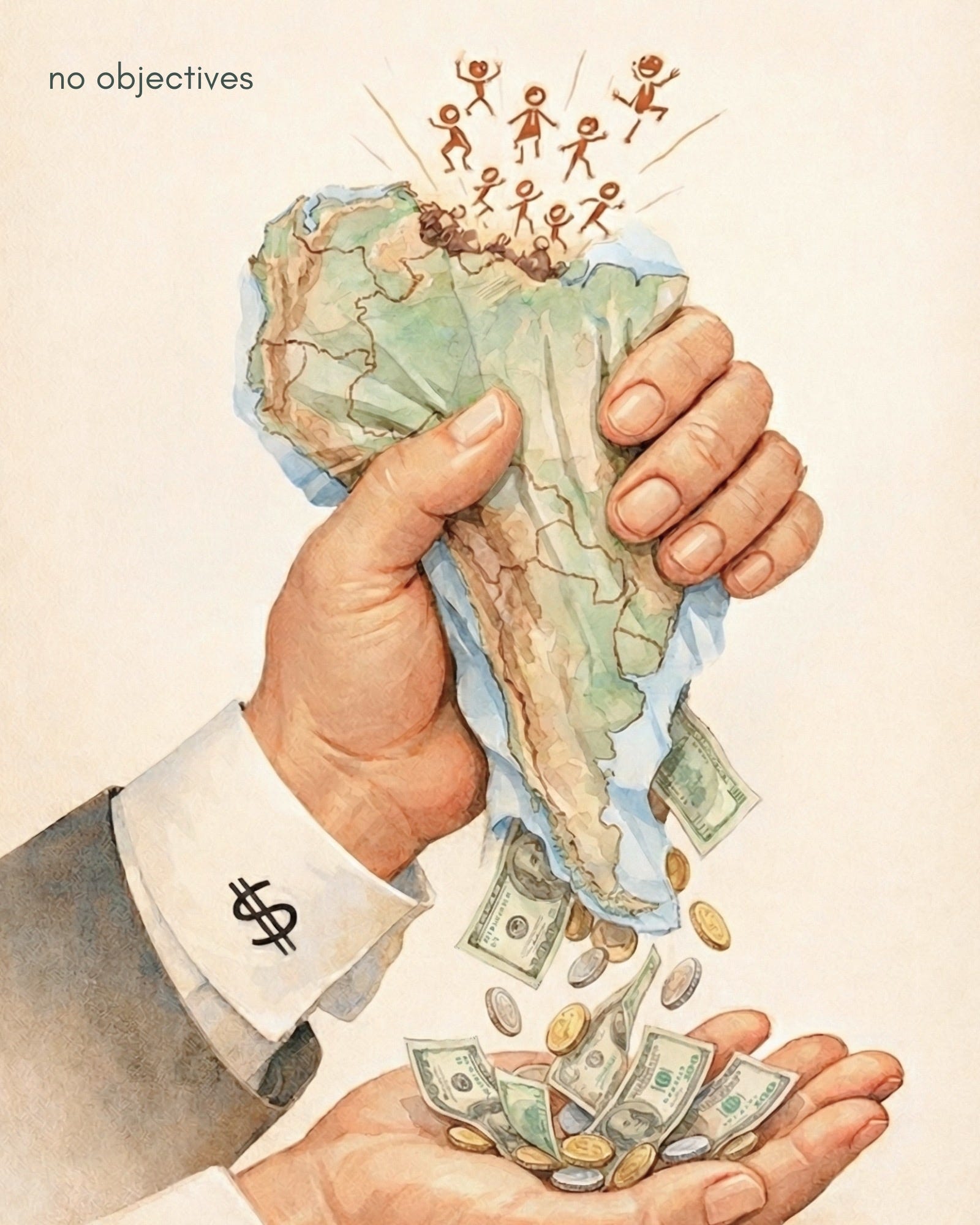
Following up on my earlier essay, this argument by Chris Morlock, rewritten for clarity, offers a sharp explanation of why Venezuela was never about oil, but about maintaining financial power for a narrow elite.
For decades, whenever the United States has gone to war or intervened abroad, a familiar explanation has appeared on the left: “They are just there for the oil.” It sounds intuitive. Oil is valuable, wars are expensive, so the assumption is that the goal must be to seize resources, flood markets, and make life cheaper back home. But this story does not survive even a basic look at history.
The United States never meaningfully extracted oil from Iraq, Libya, or the countries it destroyed. Iraqi oil did not lower gas prices in the US. It did not structurally increase supply or improve the material conditions of ordinary Americans. Iraqi production collapsed for years and only recovered much later through Chinese state-led investment, not American capital. The oil was not taken. It was largely left underground.
This was not a failure of execution. It reflects how modern capitalism actually works.
Today’s dominant economic system does not primarily generate wealth by producing goods. It does so through debt, financial contracts, fees, legal claims, and control over future income. In this system, abundance is a problem. Oversupply lowers prices and weakens financial leverage. Scarcity does the opposite. It keeps prices high, strengthens debt claims, and concentrates power.
That is why the idea of “taking the oil” is backwards. Oil is often more valuable when it is not produced, when it exists as a future promise that can back loans, derivatives, and legal claims. This is why wars and sanctions so often lead to production collapse rather than expansion.
In Iraq, the real flow of money was not oil to Americans. It was public money to military contractors, logistics firms, and security companies through no-bid contracts, endless reconstruction projects, and prolonged occupation. The result was financial enrichment for a narrow elite, not material gain for the public.
Much of the western left has responded by arguing that this behavior is immoral, that it represents theft or imperial greed. But this critique quietly accepts a false premise: that if resources really were taken, people would benefit. For populations living under austerity and high prices, this is a weak position. It concedes the ground.
The stronger truth is that these interventions do not even work on their own stated terms. They do not deliver cheap energy, prosperity, or stability. They deliver debt, scarcity, and collapse.
Venezuela makes this dynamic especially clear. The country holds enormous oil reserves, yet its oil industry has been deliberately strangled. Sanctions blocked access to dollars, spare parts, insurance, shipping, and refinancing. Production collapsed. That collapse was then blamed on mismanagement, completing a convenient narrative loop.
Once payment defaults followed, creditors activated international arbitration systems designed to protect capital, not populations. Claims were enforced not inside Venezuela, but against assets abroad, most notably CITGO in the United States. Courts treated these claims as senior, enabling asset seizure and liquidation.
At no point does this process require rebuilding oil capacity. In fact, rebuilding capacity would undermine the entire structure by increasing supply and lowering prices. The rational financial outcome is constrained production, collateralized future barrels, and externally controlled cash flows. Oil becomes valuable precisely because it stays in the ground.
Sanctions create default. Default triggers arbitration. Arbitration enables asset seizure. Asset seizure disciplines the state. Financial actors then step in to “stabilize” the wreckage through debt restructuring, equity swaps, and rent guarantees. The country is left poorer, less sovereign, and permanently dependent.
This is why the claim that “they just want the oil” is not only wrong, but inverted. The goal is not extraction. It is financial control. Not cheap gas for Americans. Not development for Venezuela. But debt, leverage, and rent.
When Trump mocks past leaders for failing to “take the oil,” he misunderstands the system he operates within. They did not fail. The system worked exactly as designed. The oil staying underground is the feature, not the bug.
The real mistake of the western left has been to argue that this system is immoral rather than fundamentally unproductive. These interventions do not create real wealth. They hollow out productive economies, concentrate power, and leave ordinary people worse off on all sides.
That is the contradiction worth exposing. Not simply that the system is cruel, but that it is empty. Extractive without extraction. Profitable only through artificial scarcity and endless debt.
Link to original tweet: https://x.com/cdmorlock/status/2008366268462874726?s=46&t=eoi37_UjXlyk1Cf-Oei1yQ&ct=rw-li
Link to my previous article: The Real Reason Why the US Overthrew Venezuela
This is a compelling inversion—that oil’s value lies in remaining unproduced as collateral rather than as energy. This helped me see more clearly that extraction itself isn’t the goal, control over when, where, and for whom extraction happens is. Sometimes that means pumping; sometimes it means collapse.
One thing I keep wondering, though, is how this framework accounts for moments when extraction is aggressively pursued elsewhere, or when resource flows matter geopolitically even if they don’t benefit the public? Still, this is one of the clearest explanations I’ve seen of how financial power, not material supply, structures these interventions. Thank you!
It's worth keeping in mind that the monetary system is an instrument of control that is designed to extract value through artificial scarcity and endless debt, which leads to an inevitable concentration of wealth and power.
There is a deliberate but artificial scarcity of state-sanctioned money because it is loaned into existence and has to be returned with interest, which keeps us in a collective state of perpetual debt servitude and ensures a continuous transfer of wealth to those who collect interest by allocating credit.