
Liquid Modernity
Why Everything Solid Melts Into Air (And Why That Should Terrify and Liberate You)

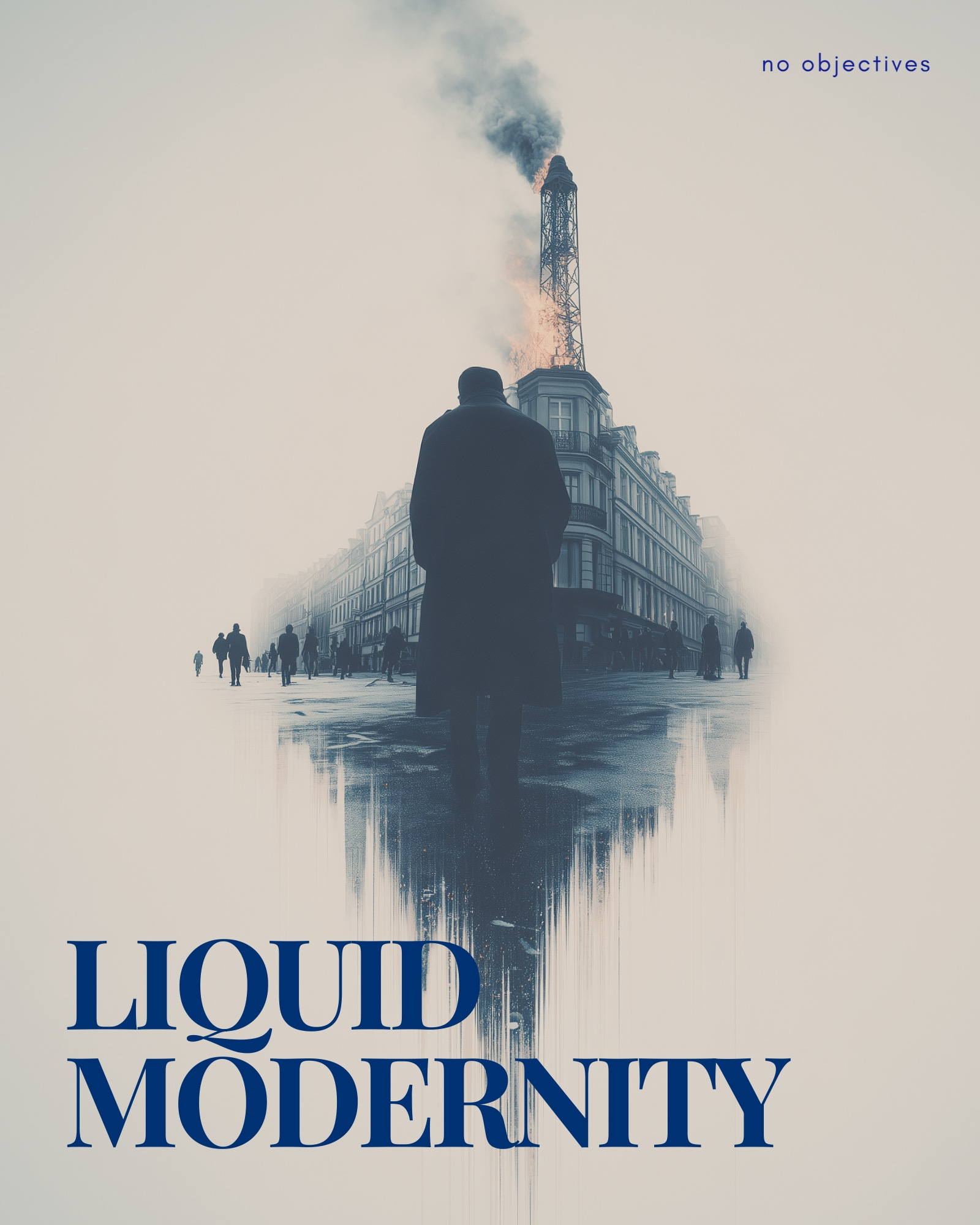
Picture this. Your grandmother probably worked at the same company for forty years, retired with a gold watch and a pension that actually meant something. Your parents might have managed twenty years before the first “restructuring.” You? You are on your third career pivot this decade, your relationship status updates faster than your software, and the only thing more temporary than your job is your sense of who you actually are. Welcome to liquid modernity, where the floor beneath your feet is not just shifting, it is actively evaporating.
The Great Melting
In 2000, Polish-British sociologist Zygmunt Bauman gave us a metaphor so perfect it hurts: modernity has gone liquid. Everything that used to be solid, careers, communities, identities, relationships, truth itself, has melted into a state of permanent flux. It is not that things are changing. It is that change itself has become the only constant, and we are all treading water in an ocean with no shore in sight.
Think about the language we use now. We do not have relationships; we have “situationships.” We do not commit to careers; we “build our personal brand” through “portfolio work.” We do not join communities; we “network” and “curate our feeds.” Even our deepest convictions come with an asterisk and a disclaimer, ready to be updated when the next trend cycle hits. We have become like water ourselves, adaptable, flowing, taking the shape of whatever container holds us, never quite solid enough to build anything that lasts.
The Terrible Freedom
Here is the thing that makes liquid modernity so psychologically devastating: it feels like freedom. No more being trapped in your father’s profession. No more suffocating small-town expectations. You can be anyone, do anything, reinvent yourself on a Tuesday afternoon. The world is your oyster, and identity is just a performance you can change like a costume.
Except freedom without foundation is indistinguishable from drowning.
Bauman understood that liquid modernity grants us enormous choice while simultaneously removing all the institutional support systems that made choice meaningful. You are “free” to design your own life path, but good luck doing it without job security, social safety nets, or a community that remembers your name. You are “empowered” to be yourself, but which self? The one you performed on Instagram this morning, or the one you will need to be for tomorrow’s job interview?
The previous generation might have felt trapped by stable structures. We feel abandoned by their absence.
The Consumption Cure
When everything solid melts, what do we grab onto? For most of us, the answer is stuff. Not just material goods, though certainly those, but experiences, identities, even relationships, all consumed like products, discarded when they no longer satisfy, replaced with the next dopamine hit.
Liquid modernity turns us into insatiable consumers of our own lives. We do not build friendships; we collect contacts. We do not develop expertise; we accumulate certificates. We do not create meaning; we curate aesthetics. The dating app model has metastasized beyond romance. Everything is now swipeable, every commitment provisional, every person just one option in an infinite scroll of possibilities.
And like any addiction, it never quite satisfies. The more options we have, the more anxious we become. The more “connected” we are, the more isolated we feel. The more we optimize and upgrade and pivot, the more we suspect we are running in place.
Enter the Undertaker: Hospicing What’s Dying
This is where things get interesting, and where educators like Vanessa Andreotti take Bauman’s diagnosis and perform radical surgery on it. Andreotti looks at liquid modernity and sees not just social transformation but death throes. Modernity, she argues, is not evolving into a liquid state. It is collapsing, and liquid modernity is its final, desperate form before the whole structure comes down.
Consider this. Bauman wrote about liquid modernity in 2000, before the 2008 financial crisis, before smartphone addiction, before the pandemic revealed just how paper-thin our social fabric had become, before we started measuring the climate apocalypse in parts per million and extinction rates. The liquidity he identified has only intensified. We are not just swimming anymore. We are gasping.
Andreotti’s provocation is both darker and stranger than Bauman’s. What if the appropriate response is not to try to re-solidify modernity or to learn to swim better in liquid times, but to hospice what is dying? To sit with modernity as it takes its last breaths, to witness its passing without trying to resuscitate it or clinging to what cannot be saved, and, most radically, to tend to something new that might be gestating in the wreckage, even though we cannot yet imagine what that something is.
This is where liquid modernity stops being just an academic concept and becomes existentially urgent.
The Ten Plagues of Our Liquid Age
Andreotti catalogs what it actually feels like to live in late-stage liquid modernity, and her list reads like a dispatch from a civilization in free fall:
Information overload so complete that truth itself becomes a matter of preference.
Everyone speaking, no one listening.
Words that mean everything and nothing simultaneously.
Emotions we cannot process accumulating like toxic waste.
Volatility and uncertainty met with desperate grasping for any certainty, no matter how false.
Consumption as a way of life, where even our activism and relationships become things we buy and discard.
The awareness that everything is narrative, including this sentence, weaponized into “believe whatever’s convenient.”
Hope repackaged as a commodity to be purchased rather than practiced.
Generational warfare between those who inherited a planet and those who will inherit the bill.
The contradiction of watching everything burn while being unable to stop adding fuel, because our entire way of life is built on the fire.
If you have ever felt simultaneously outraged at injustice and numb to suffering, desperate for change and paralyzed by choice, connected to thousands but known by none, congratulations. You are not broken. You are responding rationally to liquid modernity’s impossible demands.
Why This Matters (Or: How to Stop Drowning and Start Composting)
You might be thinking, “Cool diagnosis, but now what? What do I do with this information while I am updating my LinkedIn and doom-scrolling at 2 AM?”
Here is why liquid modernity matters: you cannot solve a problem you have misdiagnosed.
We keep trying to address our anxiety, our loneliness, our sense of meaninglessness with more of what made us sick. More productivity hacks. More self-optimization. More consuming of solutions. We treat liquid modernity like a personal failing. Why can’t I just be more resilient? More adaptable? More successful at performing stability while everything crumbles? But it is not an individual psychological problem. It is a civilizational condition.
Understanding liquid modernity means understanding that your exhaustion is not personal weakness. Your inability to commit is not moral failure. Your sense that you are supposed to be someone, but you are not sure who, is not a private flaw. It is what happens when the entire social architecture that once helped people become and remain selves has been dissolved.
And paradoxically, this recognition is liberating. Once you stop blaming yourself for drowning in an ocean, you can start asking different questions. What if the goal is not to swim harder? What if we stopped trying to rebuild the solid structures that were, let’s be honest, always more prison than protection for many people? What if we learned to compost the collective waste we have accumulated, the lies, the violence, the unsustainable fantasies, and use that decomposition to nourish something we cannot yet imagine?
Living in the Liquidation
So what does it actually look like to live consciously in liquid modernity? Not to escape it, you cannot. Not to master it, that is the trap. But to be with it without being destroyed by it.
It means developing what Andreotti calls “exilic” wisdom. The capacity to be in the system while not being entirely of it. To use modernity’s tools, language, technology, institutions, while staying awake to their limitations and violences. It means building stamina for uncertainty instead of grasping for false certainties. It means learning to compost your own complicity instead of performing innocence. It means holding space for contradictions rather than resolving them into comfortable narratives.
Most radically, it means giving up the modern addiction to solutions, answers, and redemption arcs. Living in liquid modernity requires something far more difficult: sitting with the discomfort of not knowing how this story ends, tending to what is dying while not suffocating what is being born with our desperate projections of what we think should come next.
The Floor Is Lava (And That’s Where We Live Now)
Liquid modernity matters because it names the water we are swimming in, or rather, the quicksand we are stuck in. It explains why your parents’ advice does not work, why self-help feels like rearranging deck chairs on the Titanic, why every solution seems to create three new problems, why you can be connected to everyone and understood by no one.
But naming the problem does not solve it. Perhaps the point is not to solve it at all. Perhaps the point is to stop pretending we are standing on solid ground and start learning what it means to live, with honesty, with humor, with radical tenderness, in the liquidity itself.
Because here is the secret they do not tell you. The solid ground your grandparents stood on was always partly illusion, always built on exploitation and exclusion that was convenient to ignore. The liquid chaos you are drowning in is also dissolving those old certainties, making space for something else, something that cannot emerge as long as we keep trying to resurrect what is already dead.
Liquid modernity is terrifying. It is also the only world we have. The question is not how to make it solid again. The question is what becomes possible when we finally stop pretending it ever was.
The floor is lava. It always was. And somehow, we have to learn to dance anyway.
I love your article!
It puts exactly into eloquent and thought-through words what I perceive and think.
Thanks also for mentioning Bauman and Andreotti for further exploration!
This is hegemony working perfectly in modern times : "blame yourself, optimize, you're on your own the master of your destiny, you're free". It keeps the system as is with people atomized. Then interestingly when we realize it is not working loud solutions come pointing to scapegoats: "foreigners, Muslims, gay people, the others"... Another way to keep the system. We're living Italy's 1920s and Germany's 1930s all over the west again. Since 2025 it's hard to ignore, some symptoms were visible earlier. Néolibéralism (self blame) and fascism (scapegoating) are not opposites : They are sequential stages of the same system defending itself. At no point does class consciousness develop. At no point do workers recognize their shared interests against oligarchy. At no point does solidarity across race, nationality, religion, gender emerge. The oligarchy remains unchallenged. Worse now (which didn't exist 100 years ago) many see oligarques as heros and role models (for what? Mere accumulation which becomes the end... Also didn't exist as value 100 years ago). What to do? Reject productivity culture, confront scapegoating, reject billionaires as heros, ask yourself questions (why are so many people feeling in liquid state? is there something structural? why is that? who benefits?), build community / be a villager, seek alternative narratives, organize, practice compassion, build new narratives, darr to imagine a new system, win elections, make change happen!