
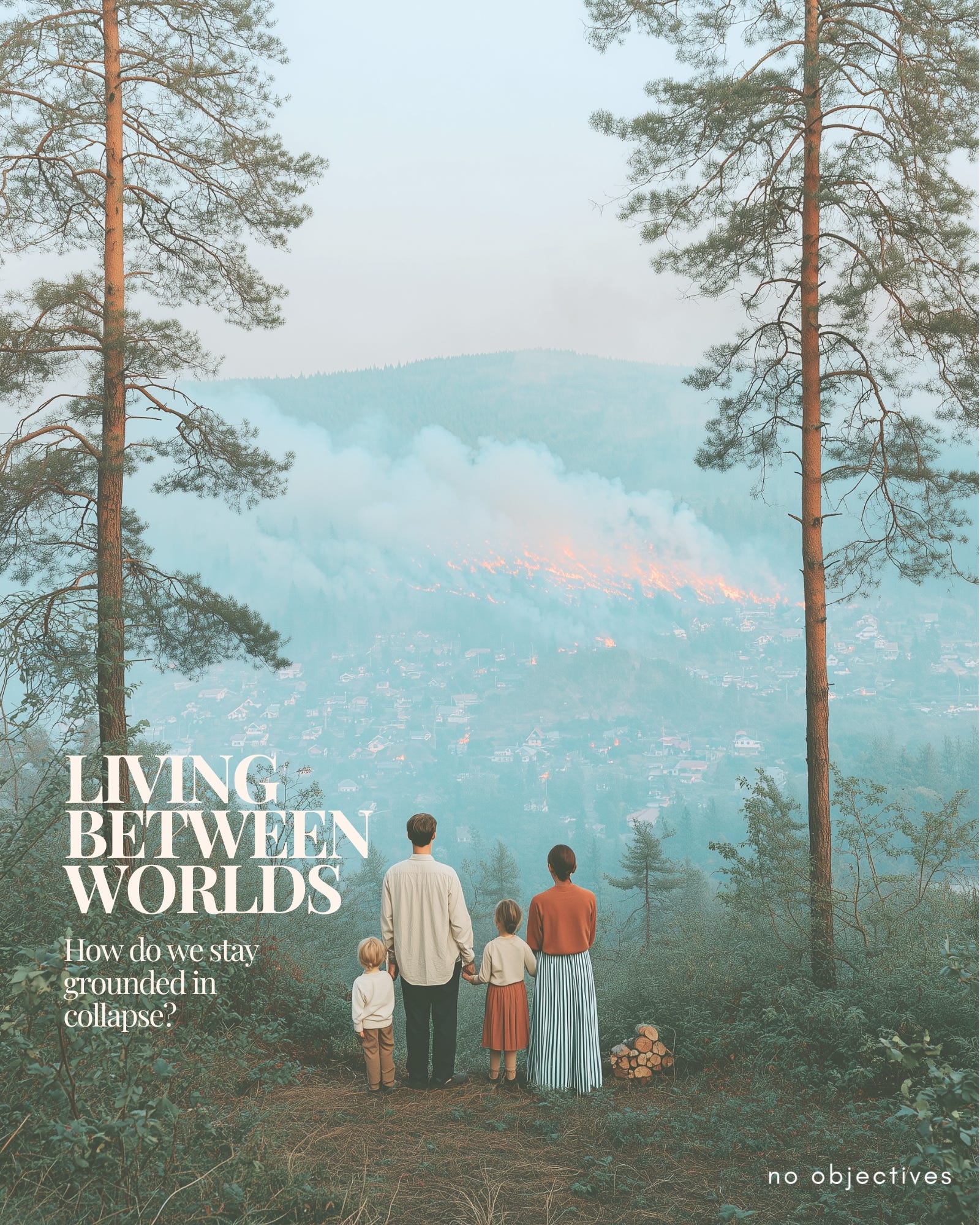
Living Between Worlds
How do we stay grounded in collapse?

Imagine waking up inside a game whose rules no longer work. You studied hard, worked hard, did what you were told, and still the reward never quite arrived. You were told justice is blind, yet some people seem able to buy sunglasses for the law. You hear that the economy is growing, markets are thriving, innovation is booming, and yet somehow groceries feel heavier, rent feels crueler, and exhaustion has become a shared national hobby.
Something strange happens in moments like this. It is not just that people become angry. They become confused in a deeper way. They no longer know how to interpret their own lives.
That is the heart of the issue explored in the ideas we have been unpacking here: when the dominant worldview of a society begins to crack, the crisis is not only political or economic. It is existential. It is cultural. It is emotional. It is, in a very real sense, a collapse in reality itself.
That may sound dramatic. But it is worth being precise. “Reality” here does not mean the physical world vanishes in a puff of smoke. It means the shared story people use to make sense of society begins to lose legitimacy. The gap between what institutions say is true and what people actually experience becomes too wide to ignore. And once that gap becomes obvious, something important breaks: trust.
The old social contract, now with cracks showing
For decades, much of modern society has been held together by a familiar script. Work hard and you will be rewarded. Play by the rules and justice will protect you. Develop valuable skills and you will become secure. Trust the economy because if the numbers look good, life is probably getting better.
This script was never fully true for everyone, of course. Many people were excluded from its promises from the beginning. But it was believable enough, for enough people, for long enough, that it helped organize social life. It gave people a map. It explained sacrifice. It justified institutions. It made the future feel legible. Now that map is tearing.
Artificial intelligence has intensified this rupture. If once expertise offered a path to dignity and security, AI muddies the picture. When machines can imitate or automate more and more kinds of knowledge work, people begin to ask an unsettling question: if skill is no longer scarce, what exactly is my value?
At the same time, people see powerful figures escaping accountability, while ordinary people face strict consequences for small mistakes. Justice begins to look less like a principle and more like a membership benefit. And then there is the economy. On paper, things often appear to be going well. Markets rise. Productivity climbs. Headlines celebrate growth. Yet millions feel poorer, more precarious, and more anxious. The official dashboard says sunshine. The lived experience says storm warning.
This creates what might be called a split-screen society. On one screen is formal reality: the polished language of institutions, metrics, performance, and progress. On the other is lived reality: debt, burnout, loneliness, distrust, and the unsettling feeling that one is somehow failing at a game designed to be unwinnable. When those two screens drift too far apart, people begin to feel gaslit by the system.
What breaks when the story breaks
When a worldview collapses, the first casualty is often meaning. If hard work no longer reliably leads to stability, then effort starts to feel less like virtue and more like self-exploitation. If justice seems selective, morality begins to feel theatrical. If the economy grows while daily life worsens, public language starts to sound fictional.
This disorientation matters because societies run not only on laws and money, but on shared belief. People need some confidence that the world is intelligible, that actions have consequences, that institutions correspond at least loosely to reality. Once that confidence erodes, cynicism becomes a rational response.
And cynicism does not stay politely contained. It spreads. People begin losing trust not only in politicians or executives, but in experts, the media, schools, credentials, courts, and sometimes even in language itself. Words like “progress,” “innovation,” “justice,” and “opportunity” begin to feel suspicious, as if they belong to an advertising campaign rather than a moral world.
At that point, a population becomes more emotionally volatile and more politically vulnerable. Why? Because humans cannot live long without meaning. If the public story falls apart, people go looking for a replacement. Some replacements are generous. Others are dangerous.
The fork in the road: solidarity or scapegoating
When people feel humiliated, confused, isolated, and powerless, they often become susceptible to simple explanations. If life no longer makes sense, a neat villain can feel like relief. This is where scapegoating enters. Migrants, minorities, “the lazy,” “the woke,” “the elites,” “the young,” “the old,” outsiders of one kind or another. The specifics vary by context, but the mechanism is familiar. People in pain want an object for their rage.
The problem is that scapegoating gives emotional clarity without structural truth. It tells a story that feels satisfying but explains very little. It turns systemic crisis into personal blame. It replaces diagnosis with theater. Yet there is another path.
The same rupture that creates danger also creates possibility. When people realize the old story no longer matches reality, they can begin asking better questions. Not “Why am I failing?” but “Why is this system producing failure at scale?” Not “Who can I blame?” but “What incentives, institutions, and concentrations of power are creating these conditions?” That shift is huge. It turns private shame into public pattern recognition. It transforms isolated suffering into the basis for solidarity.
In other words, the collapse of a worldview can become either a doorway to authoritarianism or an opening for democratic renewal.
The central insight: people need orientation, not just information
One of the most important ideas is that periods of societal rupture are not solved by facts alone. People do not only need better data. They need orientation.
They need help answering basic but profound questions: What is happening to us? Why does it feel like this? Who benefits from this arrangement? What should we protect? What should we build instead?
This is why organizations trying to create positive change have such a crucial role. Their task is not merely to propose policies or circulate analysis. Their task is to help interpret the rupture without weaponizing it. That means several things.
First, they must name the breakdown honestly. Pretending the old story still works only deepens distrust. People need to hear, clearly and respectfully, that their confusion is not a personal defect. It is a rational response to structural dissonance.
Second, they must turn private pain into public pattern. Burnout, loneliness, precarity, debt, ecological grief, and distrust are not random glitches. They are symptoms of larger systems organized around extraction, concentration of power, and abandonment of public goods.
Third, they must direct anger toward structures, not vulnerable people. This is a subtle but essential move. Anger is not the enemy. Misplaced anger is. The villain, if we need one, should be concentrated power without accountability, institutions that reward extraction, economies that value price over life, and politics that protect wealth more reliably than truth.
Fourth, they must replace the demand for more insight with the demand for more action. People already know enough to see that the current system is failing. What is missing is not awareness, but pathways to act. The real challenge is not understanding what must change, but knowing how to make change possible. We are drowning in insight but starving for action. That is not spin. It is orientation.
Why this matters in the real world
All of this might sound abstract, but its implications are intensely practical. When people no longer believe the official story, democracies become fragile. Social trust declines. Polarization intensifies. Public discourse becomes more theatrical and less truthful. Conspiracies spread more easily. Strongmen start looking, to some, like translators of chaos.
At the same time, this moment opens space for organizations, movements, and institutions that can make complexity understandable and collective action feel possible.
This means the work ahead is not simply to criticize the old system, though criticism is necessary. It is also to make alternatives visible. Shared ownership. Community energy. Housing cooperatives. Citizen assemblies. Repair cultures. Mutual aid networks. More democratic forms of decision-making. Economies organized around care, sufficiency, and resilience rather than endless accumulation.
People do not fight for a better system because they have read the correct white paper. They fight for it when they can see it, feel it, and participate in it.
That brings us to one of the sharpest insights in this whole discussion: agency is anti-scapegoating.
When people feel they are co-authors of change, they are less likely to seek emotional rescue through blame. Participation itself becomes stabilizing. It gives people a role in history rather than leaving them as spectators of decline.
This is why belonging matters so much. Many change organizations make the mistake of leading with analysis when people are actually starving for human connection and moral orientation. The future will not be built by facts alone. It will be built by communities that make people feel seen, useful, and invited.
Or put more simply: no one wants to join a better world if they suspect they will be scolded upon arrival.
The deeper question beneath the crisis
Perhaps the deepest issue raised by this worldview collapse is not economic at all. It is moral. If merit no longer guarantees dignity, if markets no longer reflect well-being, if institutions no longer reliably embody justice, then societies are forced to confront a question they have long tried to avoid:
What is a person worth, beyond productivity?
That is the question lurking beneath the anxiety around AI, labor, and status. If machines can do more of what once made humans economically distinct, then we cannot keep grounding human value primarily in market usefulness. We need a richer foundation.
Care. Reciprocity. Interdependence. Democratic participation. The ability to contribute to a shared world. The dignity of being human, full stop. This does not mean expertise no longer matters. It does. It means expertise alone can no longer serve as the moral architecture of belonging. And perhaps that is not only a loss. Perhaps it is also an invitation.
A society between stories
We are, in many ways, living between stories. The old one is breaking down. The new one has not yet fully arrived. That in-between space is deeply uncomfortable. It can feel like grief, vertigo, exhaustion, and moral confusion all at once. But it is also a generative space. It is where new language begins to form, where new solidarities can emerge, and where new institutions can be imagined.
The crucial question is how this transition is understood. Because if people are left alone to make sense of rupture, without honesty, care, and structural clarity, others will do it for them. And they may do so through fear, resentment, nationalism, purity, exclusion, and revenge.
So the task is not simply to win a narrative. It is to tell a truer social story. One that says: You are not crazy. You are not alone. This is not simply your personal failure. These conditions are being produced by a system. That system can be changed. And you have a role in shaping what comes next.
But a new world is not born from insight alone. It is not created by better language, or better questions, or hope by itself. Asking the right questions matters because it helps us see more clearly. It opens up possibility. It loosens the grip of what once seemed natural or inevitable. But questions only matter if they lead to practice.
Hope, on its own, does not build anything. Action does.
There is no hope without action.
Because values doesn’t enable action, in fact it’s the other way around. What we do shapes what we come to value. Through action, solidarity becomes real. Through action, courage becomes contagious. Through action, new ways of living stop being ideals and start becoming habits, relationships, and institutions.
That is why the practices we choose now matter so much. They are not abstract ideals. They are seven things you can do to stay grounded in collapse, while helping shape what comes next.
1. Build Real Community: True power lies in connection. Create support networks rooted in compassion, cooperation + shared resources. These are your resistance.
2. Use Your Voice: Fascism thrives on silence. Speak up—in protests, in art, in conversation. Even small truths can ripple into change.
3. Practice Radical Self-Care: Protect your peace. Rest is resistance. Joy is fuel. You can’t build a new world from burnout.
4. Align with True Abundance: Scarcity is a lie. Abundance lives in love, time, connection, and what you give—not just what you have.
5. Shift from Consumerism to Consciousness: Buy less. Live intentionally. Support what aligns with your values. Let simplicity become a form of rebellion.
6. Anchor the Future Now: Act like the world you dream of already exists. Be the bridge between what is and what could be.
7. Stay in Purpose: You’re not here by accident. Let your work + creativity be your offering to the new world.
These are not small personal gestures. They are ways of rehearsing another world into being. This is not naive hope. It is disciplined hope. Hope that refuses denial. Hope that looks directly at fracture and still chooses to organize, care, speak, protect, and build. If the old reality is losing legitimacy, then the question is not whether change is coming. It is already underway. The question is what kind of change this moment will produce. Will it harden into fear, or open into solidarity?
That is a political question. But it is also a moral question, a civic question, and a practical question. So perhaps the task now is not only to explain collapse more clearly, but to practice transition more deliberately.
Because when the world stops making sense, the people who help others make sense together, and act together, become the stewards of a new world.
Sources:
If you want to start making sense of the collapsing world, I highly recommend these programs and institutions.
1. Design School for Regenerating Earth, by Joe Brewer
An online learning space for people who want to reconnect theory and practice through bioregional regeneration, earth systems thinking, and grounded work in place.
Link: Design School for Regenerating Earth.
2. r3.0, by Bill Baue and Ralph Thurm
A regenerative transformation platform that helps people and organizations move beyond incremental sustainability and toward context-based, systems-level change.
Link: r3.0.
3. Beyond Duality, by Erin Remblance and Kasper Benjamin Reimer Bjørkskov (Full disclaimer, I am the co-founder of this course)
An 8-week online course exploring transition, power, ecology, and unlearning modernity, helping people align their work and lives with a truly life-supporting future.
Link: Beyond Duality
This isn't just a brilliant piece, it's a fucking brilliant piece.
Here in the UK, The Green Party is seeing a huge surge in support, as it proposes a better system. Their latest video aligns incredibly well with what you are saying - and is well worth a watch.
https://youtu.be/bF_a_w7Dozo?si=mGAHmRr6mxeDrKII
These are very important ideas, Kasper. I see this in education, as many begin to ask, what is education for? I would add, together with your excellent seven points for staying grounded, that it is important to stay, literally, grounded- connected to the more than human world, finding belonging there, in the web of Life, first and foremost. Thank you for this discussion!