
Movements Prepare for the Crisis. Money Prepares for the Response.
Why the same crisis produced the welfare state in Denmark and Hitler in Germany.

This is part 3 of a 4 part summer series on why the world resists the change it needs, and what would actually deliver it. Four essays, one argument: limits are the answer, the system refuses them, only organized power can impose them, and that power is already in us.
If only the crisis were big enough, we would finally act. You have heard this, maybe you have said it,. I have. It lives in every climate conversation, every debate about runaway AI, every late-night exchange between campaigners who have watched governments do nothing for decades. One day the flood will be high enough, the heat will be hot enough, the collapse will be visible enough, and then the system will change. It is hope disguised as analysis. We are not failing, the thinking goes. We are just waiting for the wake-up call.
The historian Roman Krznaric has pushed back on this, and his argument deserves to be taken seriously before I make a gentle critique. A crisis alone, he says, almost never transforms anything. In his book History for Tomorrow he offers a model he calls the Disruption Nexus: rapid, transformative change needs three ingredients working together. First the crisis itself, a political, financial, technological or ecological rupture that destabilises the system and makes the unthinkable thinkable. Second the movements, people in the streets who amplify the crisis and turn a technical problem into a political one. Third the visionary ideas, worked-out models of what should replace the old system, developed in advance so they can be put on the table with credibility when the moment arrives. Crisis, movements, ideas. None of them alone is sufficient. A neat triangle. Below you can see a diagram of the “The Disruption Nexus” by Roman Krznaric.
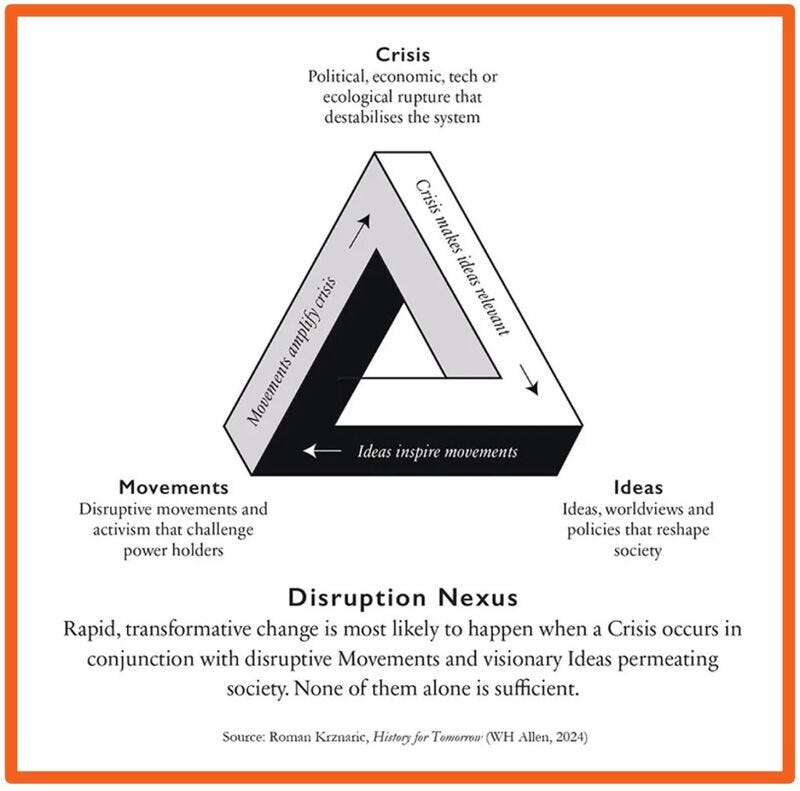
As proof he points to 2008. The crash was enormous, the biggest rupture in the global economy since the Great Depression. Occupy spread across the globe within months. But Roman Krznaric claims that it failed because there were no credible alternative economic models with a strong public profile, no worked-out vision ready to go. And so, the argument runs, we bailed out the banks and left the old system intact. The lesson he draws is the Scouts’ motto: be prepared. Organise your movements now. Develop your ideas now. Have everything ready for the day the door opens. It is a better theory than waiting for the wake-up call. Its advice is not even wrong, but the nexus is missing the ingredient that decided every example it rests on, the ingredient that decides who actually walks through the door.
Power.
Start with the story that seems to prove the triangle best: the fall of the Berlin Wall in 1989. East Germany had the crisis, a leadership paralysed by Gorbachev’s reforms. It had the ideas, democratic ideals of free speech and free movement. It had the movements, mass protests swelling in Leipzig and then Berlin. All three ingredients, and the wall came down. But look closer. Eastern Europe had seen crises, ideas and uprisings before. Hungary in 1956. Prague in 1968. Both times every ingredient was present, and both times Soviet tanks decided the outcome. What changed in 1989 was not the recipe. It was that Gorbachev withdrew the force that had always held the system up. The regime’s power evaporated, and the protests filled the space it left behind. The wall did not fall to a triangle. It fell to a missing army.
Now return to 2008 with the same eyes. The story says the crash transformed nothing because the visionary ideas were missing. That claim does not survive contact with one man. When Occupy Wall Street erupted in Zuccotti Park in 2011 and spread to hundreds of cities within weeks, one of its leading voices was the anthropologist David Graeber, the man behind the slogan about the 99 percent. He did not arrive empty-handed. He had just published Debt: The First 5,000 Years, and he carried a full programme with him: cancel the unpayable debts, declare a jubilee, democratise finance, rethink what money is for. Around him circulated worked-out proposals for public banking, cooperative ownership, and taxing the transactions that had blown up the world. The ideas filled books, teach-ins, think tanks, and living rooms. Vision was the one thing Occupy had in surplus. So if the ideas were there, and the movement was there, and the crisis was there, why did nothing change? Because something else was also present, organised and fully prepared: the finance lobby, which captured the crisis response within weeks of the crash, staffed the recovery teams with its own people, and wrote its own bailout terms. Graeber and the movement had visions. The banks had the Treasury’s phone number. The ideas did not lose to an empty table. They lost to a stronger opponent who had never left it. And if you want to see what really decides the direction of a crisis, look at the 1930s, and look at two countries hit by the same depression at the same moment: Denmark and Germany.
On the evening of 30 January 1933, in an apartment in Copenhagen, the Danish prime minister Thorvald Stauning sat down with the leaders of the farmers’ party and negotiated through the night, reportedly with whisky on the table. The depression had crushed agricultural exports and sent unemployment soaring, and the country needed a response. What came out of that night was a grand bargain: the krone was devalued to save the farmers, lockouts were suspended to protect the workers, and a sweeping social reform turned poor relief from charity into rights. It became the foundation of the Danish welfare state. Crisis walked in the door, and organised labour and organised farmers, each with decades of unions, cooperatives and parliamentary muscle behind them, wrote the response together.
That same day, a few hundred kilometres south, Adolf Hitler was appointed chancellor of Germany.
Germany had the same crisis, and worse. It had movements, millions organised in unions and parties. It had ideas, detailed programmes for employment, planning and reform. Every corner of the triangle was present in abundance. But the coalition that captured the German crisis was a different one: old conservative elites, large landowners, army leadership and sections of industry who decided that handing power to a fascist movement was preferable to letting the left shape the response. They believed they could control him. History keeps a special folder for men who believe that. The workers’ movement, split down the middle between social democrats and communists, could not match their organised weight at the decisive moment. Same depression. Same decade. Same day, even. One country got the welfare state. The other got the Third Reich. The ingredients were identical. The balance of organised power was not. This is the fourth ingredient, and it is not an abstraction. It is a question you can ask of any crisis, past or coming: who is organised enough to write the response?
Because a crisis does not choose a direction. It opens a door, and whoever is strongest walks through first. If the nexus were sufficient, the climate crisis plus Fridays for Future plus Doughnut Economics should already have delivered transformation. It hasn’t. Because incumbents also read the Scouts’ motto. They prepare for the crisis moment too, and they arrive with better funding and standing access to the state. Preparing for the crisis moment is their full-time, salaried job. Every time the door opens, the fossil lobby walks through first, and the moment is spent softening targets instead of raising them.
So here is the model I would draw instead, and it is not a triangle. Picture a wall with a gap blown open in it. That is the crisis, and the gap has no opinion about who passes through. Below it sits a seesaw. On one side of the beam sit your ideas and your movements, everything the nexus told you to prepare. On the other side sit the money, the lobbyists and the standing access to the state. And the fulcrum the whole thing balances on is power. Tips one way: transformation. Tips the other: business as usual, restored and reinforced.
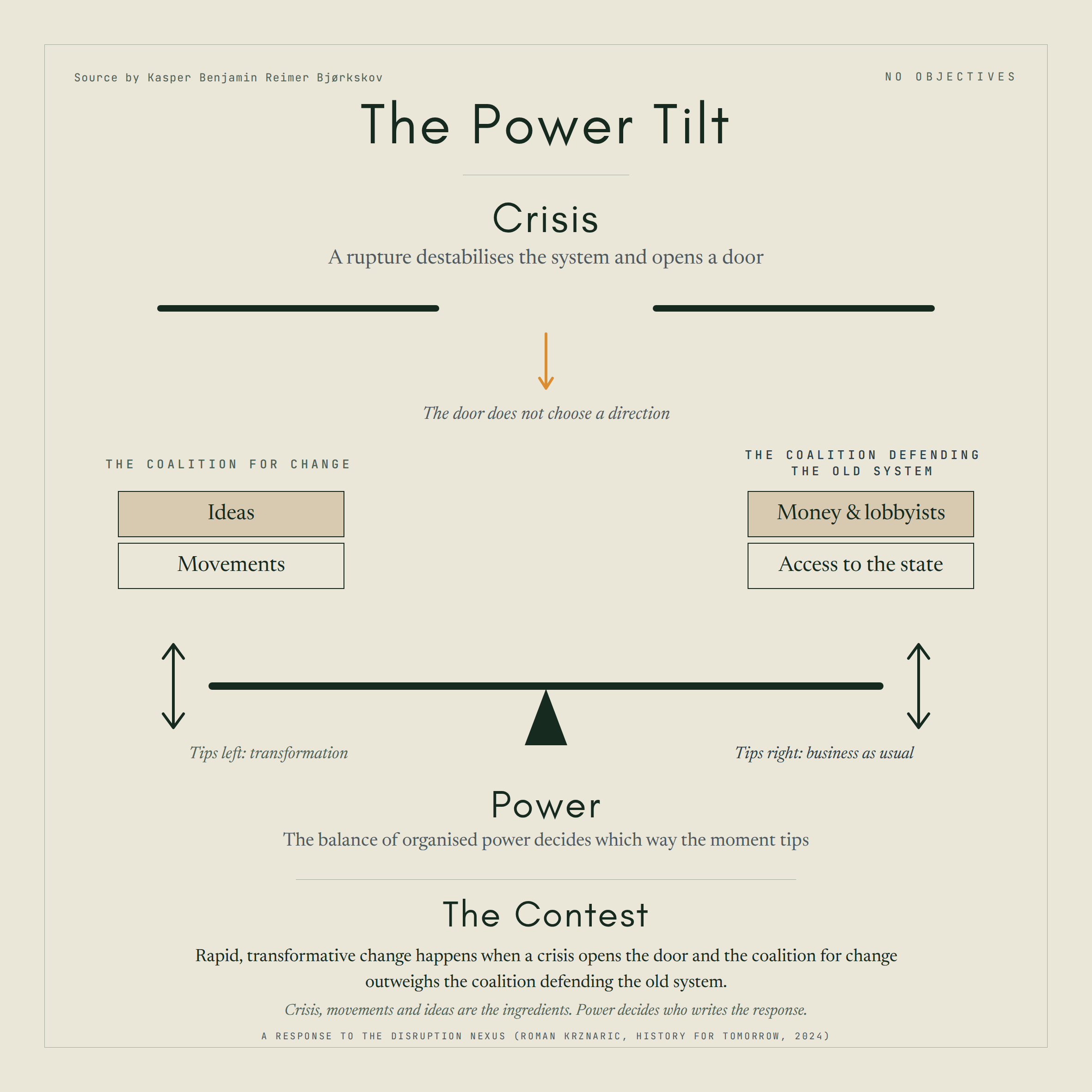
Call it the Power Tilt. It is less elegant than a triangle, and that is the point. Change is not a recipe you complete. It is a weigh-in you win or lose. Denmark did not get its welfare state because its ideas were prettier than Germany’s. It got it because workers and farmers had spent decades organising, in unions, in cooperatives, in parties, stacking their side of the beam long before the depression ever hit. When the door opened, they did not need to start building power. They only needed to use it. That is the work in front of us, not waiting for a bigger crisis and not polishing a better model. Organising by building the coalitions, the alliances and the institutions heavy enough to outweigh the side defending business as usual. They are already seated, already funded, already stacking their end of the beam. Every union joined, every alliance formed, every sector organised is weight on ours. So yes, be prepared. But understand what preparation means:
The crisis opens the door. Ideas point the way. Movements push. But only organised power walks through first. Stop waiting for the moment and start building the weight.
"The wall did not fall to a triangle. It fell to a missing army."
A profound, thought-provoking take on what really causes systemic change. The point about the divergence between Denmark and Germany on that same fateful day in January 1933 drives the message home even more.
How well does this model apply to what happened in America in 2016, and again in 2024, in reverse? What was the crisis that opened the door to a 'rough [orange] beast, slouching in from Bethlehem?' What, precisely, was waiting to be born that most of us couldn't or wouldn't grasp, at the time? Would be curious to hear the reaction of others.
I think your model is still too simple - particularly for the US. There isn't a single fulcrum (power). The two-party, FPTP system, (both backed by big money), placed towards the ends of the beam, prevent it from tipping. You don't have a seesaw. You have this:
______________________________
. . . . . . ^ . . . . . . . . . ^ . . . . . . .
It's a win-win for money/power. And a completely neutered electorate, who's "choice" is extreme fascism vs watered down fascism.