
The Immune System
Why the left's internal conflict is the thing that keeps it alive

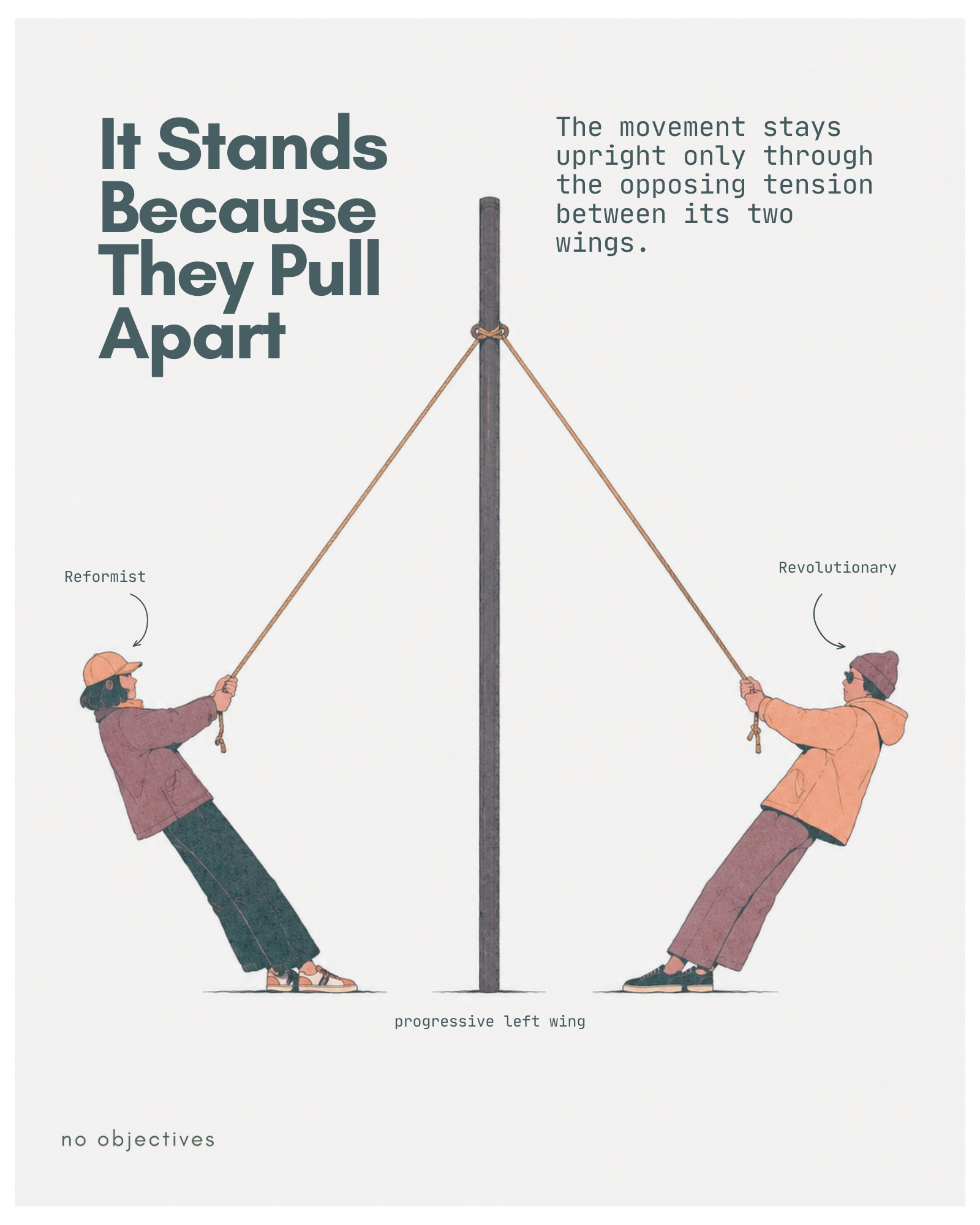
In 1984, an American sociologist named Herbert Haines published a paper that should have settled an old argument inside the left. It didn’t. The argument is louder now than it has ever been. Haines went through the funding records of seven major civil rights organisations across the years 1957 to 1970, testing a hypothesis the moderate left had treated as obvious for a generation. The hypothesis: that the Black Panthers and the militant flank of the Black Power movement had scared white liberal donors away from the NAACP and the other respectable civil rights groups. Backlash. Common sense.
The data said the opposite. As the radical wing grew louder, funding to the moderate civil rights organisations went up, not down. The angrier the Panthers got, the more money the NAACP took in. The dynamic was so consistent it became its own concept in the academic literature. It is called the radical flank effect. This is not a curiosity from a dead decade. It is the single most important piece of evidence the left has about how it actually wins, and it is the one we keep refusing to deploy in our own defence. Now imagine the inverse. A movement that suppresses its internal radical flank in the name of unity. A movement that treats the comrades on its left as an embarrassment to be managed rather than a pressure that produces concessions. That movement does not become more effective. It becomes more polite. It loses the leverage that made the moderates worth listening to in the first place. And then it dies, usually slowly, occasionally violently, always in a particular way.
In 1918, German socialists entered government and hired right-wing militias to murder their own anti-war comrades. One of the murdered was Rosa Luxemburg. She had warned them, nineteen years earlier, exactly how it would end.
“With the entry of a socialist into the government, and class domination continuing to exist, the bourgeois government doesn’t transform itself into a socialist government. A socialist transforms himself into a bourgeois minister.”
She wrote that in 1899. The people who proved her right were her own comrades. They did not need the right to come for her. They did the work themselves, in coalition, in office, with the machinery of the state they had been elected to administer. The lesson was not that the right is dangerous. Everyone already knew that. The lesson was that the state is a machine, and the machine reshapes whoever runs it faster than they can reshape the machine. That argument is a hundred and twenty-five years old. It is alive inside every left movement on earth today.
The accusation that will not die.
It is why Zohran Mamdani gets hit from the left as well as the right. It is why Bernie Sanders, the DSA, Avi Lewis, and Zach Polanski face the same charge from revolutionary socialists. The accusation is not personal. It is structural. The capitalist state is built to facilitate capitalism. You can run a socialist through it, and the socialist will arrive at the other end administering the thing they were elected to dismantle. Reform becomes a conveyor belt. It absorbs revolutionary energy. It buys time. It kicks the crisis down the road.
This is not a hypothesis. It is documented. It has happened in country after country, decade after decade, and the pattern is so consistent that to deny it requires a kind of historical amnesia that the left, of all movements, cannot afford. We are the ones who claim to take history seriously. We have to take this part too.
The case file.
Canada is the case file. Democratic socialism in Canada won universal healthcare. It won a Charter of Rights. Real gains, concrete goods, the kind that keep ordinary people alive. Children who would have died of treatable illness lived. Workers who would have been bankrupted by a hospital stay kept their homes. These are not small things. I will not pretend they are. And now, provinces are selling that healthcare to corporations. A Liberal Prime Minister is steamrolling Indigenous rights so that pipelines can be built faster. The oligarchs never stopped. They simply waited. They knew the machine was theirs. They knew the reforms would have to be defended forever, by people who would eventually get tired, get older, get bought, or get replaced.
Every concession won inside the capitalist state has an expiry date, because the state itself does not change. The reformer wins a battle and walks away believing the war is over. The capitalist class never walks away. It hires lawyers and lobbyists and economists and waits a generation, and then it takes the thing back. Sometimes it takes it back piece by piece, so slowly that no single act feels like a betrayal. Sometimes it takes it back in one shock, while the public is distracted by a war or a pandemic or an election spectacle.
And yet the reforms that have lasted longest, anywhere on earth, are the ones that had a credible threat of something worse standing behind them. In 1941, A. Philip Randolph threatened to march one hundred thousand Black workers on Washington unless Franklin Roosevelt desegregated the defence industries. Roosevelt signed Executive Order 8802 six days before the planned march. Seven years later, Randolph pushed Truman into Executive Order 9981, ending segregation in the armed forces. Workplace safety law in the United States advanced in the 1930s when armed sit-down strikes were shutting General Motors plants down. Universal suffrage in the United Kingdom advanced when suffragettes were burning postboxes and breaking shop windows, not when suffragists were writing polite letters. Every concession the moderate left celebrates as its own was paid for, in advance, by the people standing further left and refusing to bargain.
Luxemburg’s answer was to show the bourgeois state the door. Break it, refuse it, build something else in its place. Democratic socialism’s answer was to slow the state down from within, to wrest concessions, to soften the worst of capitalism while we wait for something better to become possible. Both answers can fail. Revolution can fail through cycles of violence that consume the people they were meant to liberate. Reform can fail through the slow paralysis of compromise, where every victory gets clawed back the moment the revolutionary pressure that produced it dissipates. There is no clean path. Anyone who tells you there is, is selling you something.
Where I stand.
Here is my position. I am a revolutionary. I believe the machine has to come down. I do not think it can be renovated into something humane, because its purpose is not humane and never was. The state we live inside was designed to protect property and accumulation. You cannot retrofit it into a vehicle for liberation any more than you can retrofit a slaughterhouse into a sanctuary by changing the signage. But I hold space for both tendencies, and I think the conflict between them is the most important thing the left has. The pressure from revolutionaries is what stops reformers from drifting into managers of the system they were supposed to change. Without that pressure, the reformer becomes the minister. The minister becomes the administrator. The administrator signs the pipeline. The pressure from reformers is what stops revolutionaries from sliding into rupture for its own sake, untethered from the people they need to bring along. Without that pressure, the revolutionary becomes a sect. The sect becomes a posture. The posture becomes irrelevant.
I need reform comrades even though I am not one of them. They hold ground I cannot hold. They win the concrete goods that keep people alive long enough to fight another day. And they need me, even when they hate the question I keep asking, because the question is the only thing standing between their movement and its absorption. Neither side wins the argument. That is the point. The argument is the discipline. The argument is also, as Haines proved in those funding records forty years ago, the mechanism by which both sides actually make progress.
The objection that proves the case.
When people get upset that leftists are criticising what they call their own, they are missing the point so completely that the mistake itself is diagnostic. They are not protecting the movement. They are protecting their own discomfort. And they are quietly proving they are not really interested in change, because change is not a vibe and it is not a consensus and it is not a brand. Change is a confrontation with power, and power does not yield to people who cannot tolerate disagreement with their own friends. A movement that cannot sit inside conflict without flinching cannot sit inside the much harder confrontation that is waiting on the other side. If you cannot handle a comrade challenging your strategy, you will not handle the police, the press, the donor class, the courts, the oligarchs, or the long slow grinding pressure of a state designed to outlast you. The argument with your own people is the easy version. It is the training ground.
Because, the goal of social movements isn’t to homogenize thought, it’s to harmonize action. Divergent views aren’t a threat, they’re the bridge.
This is important to understand because there is a particular kind of person who shows up to every left disagreement saying, in some variation, that we are doing the right’s work for them. Stop fighting each other. Close ranks. Present a united front. I understand the impulse. I also think it is wrong, and I think it is wrong in a specific way that matters. Unity is not the goal. Honesty is the goal. A united movement that has stopped asking hard questions of itself is not a movement. It is a brand. Brands lose to power because brands are built to be liked, and power does not care whether you are liked. Power cares whether you can take a hit and keep coming. The internal argument is how we learn to take hits without falling apart.
The immune system.
This is what the loudest critics of left infighting refuse to see. The conflict is not the disease. The conflict is the immune system. It is the thing that keeps reformers from becoming ministers and revolutionaries from becoming sects. It is the friction that keeps the whole movement honest enough to survive the next fifty years, because we are going to need fifty more years, and the version of the left that arrives there intact will be the one that learned how to disagree with itself without breaking. Every healthy body fights itself a little. The cells that do not respond to internal correction become tumours. The movements that do not respond to internal correction become parties of order, indistinguishable from the thing they once opposed. The German socialists who killed Luxemburg were not bad people who turned. They were ordinary people who silenced the immune response inside their own coalition because it was uncomfortable to hear it. Then the body died. Rosa Luxemburg understood this. She did not lose her argument with the German socialists because her argument was wrong. She lost it because they could not bear to hear it. They wanted unity. They got a coalition with the right and a militia at her door. The next century was built on that silence.
What this asks of us.
So when the next round of left infighting arrives, and it will arrive, ask yourself a different question. Not whether the criticism is comfortable. Not whether it embarrasses you in front of the people you wanted to convince. Ask whether the criticism is true. Ask whether the person making it is doing so because they want the movement to be better, or because they want it to be smaller. Ask whether your discomfort is the discomfort of a body fighting an infection, or the discomfort of a body refusing to acknowledge one. A united movement is not the goal. An honest one is. The argument is what keeps us honest. The conflict is what keeps us alive. The friction between us is what makes us progress. And the people who tell you to put the argument away for the sake of the cause are, without knowing it, telling you to disarm the only mechanism the cause has for staying recognisable to itself across time. Hold the discipline.
Sources
Herbert H. Haines, “Black Radicalization and the Funding of Civil Rights: 1957–1970,” Social Problems 32, no. 1 (1984): 31–43. https://www.jstor.org/stable/800260
Herbert H. Haines, Black Radicals and the Civil Rights Mainstream, 1954–1970 (University of Tennessee Press, 1988). https://utpress.org/title/black-radicals-and-the-civil-rights-mainstream/
Rosa Luxemburg, “The Dreyfus Affair and the Millerand Case” (1899), source of the “a socialist transforms himself into a bourgeois minister” passage. https://www.marxists.org/archive/luxemburg/1899/11/dreyfus-affair.htm
Rosa Luxemburg, Reform or Revolution (1899). https://www.marxists.org/archive/luxemburg/1900/reform-revolution/
Executive Order 8802 (Franklin D. Roosevelt, 25 June 1941), banning discrimination in the defense industry, signed six days before Randolph’s planned march. U.S. National Archives. https://www.archives.gov/milestone-documents/executive-order-8802
Executive Order 9981 (Harry S. Truman, 26 July 1948), ending segregation in the armed forces. U.S. National Archives. https://www.archives.gov/milestone-documents/executive-order-9981
One of your best pieces yet, a really sharp and digestible argument about this innate tension in the left, why it's a defining factor of our movement and good reasons for why we should never extinguish it; thanks for sharing 🤙🏽
Brilliant as ever.
And if ever proof was needed, (that you are bang on), just look at the UK Labour Government. In fact, look at the Labour party, before it was elected. In the years running up to the 2024 General Election, they "cleansed" the party of revolutionaries. What we now have is a party, that was formed to represent the working class, but is minding the capitalist shop.
There is also proof, here in the UK, that revolutionaries, attract support and funding. The Green Party have seen huge growth since Polanski became leader, pushing a far more "extreme" left-wing agenda.
#VoteGreen
#PowerToThePeople
#FreedomForTooting - you need to have watched Citizen Smith, to get that one! :-)