

The Most Radical Post Growth Text I Read This Year Came From Wall Street
And it will teach you how to build a financial portfolio fit for a post-growth future.
The most radical degrowth text I read this year was not written by an activist. It was written by a Morgan Stanley wealth adviser.
This article is a condensed version of “The Post-Growth Perspective: A Client-Aware Framework for Resilient Portfolio Construction” by Noel Pacarro Brown, a Morgan Stanley wealth adviser and vice-chair of standards at the Investments & Wealth Institute. It is one of the best post-growth arguments I have read, and it is brilliant precisely because of where it was published: not in an ecological economics journal, not on a degrowth blog, but in the professional literature that financial advisers read to stay licensed, credentialed, and employed. What follows is her argument, retold.
Start with the foundation. In 1952, Harry Markowitz published modern portfolio theory, the mathematics that still sits underneath almost every portfolio your pension fund, your adviser, or your robo-app builds today. It taught the industry to stop judging assets one by one and start combining them, to maximize expected return for a given level of risk. Diversification, the efficient frontier, and the capital asset pricing model that followed all flow from that insight. Seventy-four years of financial practice rest on it.
And underneath all of it sits an assumption nobody prices: perpetual growth, with continuous access to natural resources and labor, and global trade that stays stable forever. The models do not ask what happens when the shocks get bigger, faster, and systemic. They assume the world of 1952 keeps going.
Brown’s first move is the one that makes this piece dangerous, in the best sense. She does not appeal to morality. She appeals to fiduciary duty. Citing a 2025 legal examination by Zuiker and colleagues, she notes that fiduciaries are obligated to build processes that identify and respond to changing circumstances and knowledge. When a client sits across the table and voices anxiety about climate risk, wealth disparity, or global conflict, they are asking for more than empathy. They want their adviser to respond, professionally, to risks the standard models ignore. An adviser who dismisses those concerns may be missing critical risk factors. That reframing matters. It turns post-growth thinking from a values preference into a professional obligation.
Then comes the evidence. Brown grounds her case in the 1972 MIT study The Limits to Growth, the system dynamics model that simulated resources, industrial output, food, pollution, population, and welfare through the coming century. The model ran multiple scenarios. The business-as-usual runs, based on historical averages, peaked and then declined steeply. A second version with double the nonrenewable resources bought time and then declined anyway. Not one scenario produced endless growth. The gentlest outcome was the one called Stabilized World, where humanity deliberately let go of industrial output growth and redirected resources toward nature, health care, and education.
For fifty years that study was mocked as doomerism. Then researchers started checking it against reality. Gaya Herrington’s 2021 update, followed by Nebel and colleagues in 2024, compared five decades of empirical data against the original scenarios. The real world tracks the two business-as-usual runs most closely. One projects a managed slowdown. The other projects collapse, driven largely by pollution, which includes greenhouse gases. Neither supports continued GDP growth as a viable path.
Brown draws on Herrington’s framing of what comes next. Post-growth economics is not one school but a family: degrowth, which calls for a deliberate and fair reduction in material throughput; steady-state economics, which aims for a stable economy inside ecological limits; and the wellbeing economy, which swaps GDP for human and ecological flourishing as the goal. The shared question shifts from how do we grow more to do we have enough, and is it shared fairly. Some things should still grow, like clean energy, education, and care. Other things should not. We are already in overshoot, consuming faster than the planet regenerates. Herrington puts the choice plainly in the title of her TED talk: will the end of economic growth come by design, or by disaster?
Here is the part that lifts this article above almost everything else in the genre. Brown does not stop at diagnosis. She builds the portfolio.
The premise inverts everything advisers are trained to do. In a post-growth portfolio, returns are a byproduct of construction, not its objective. The first principle is preserving real capital, which means releasing the attachment to growth as the primary goal. Think of a farmer in a drought year. The goal is not a record harvest. The goal is keeping the farm, so there can be a harvest next year and the year after that. From there she stacks four more principles, and each one has an everyday shape. Generate durable cash flows: a rented-out apartment that pays every month beats a lottery ticket that might pay once. Maintain optionality and the ability to reverse course: rent the machine before you buy the factory. Limit exposure to systemic collapse modes: after 2020, nobody needs convincing that a virus in one city can close shops on every continent, so build as if the next shock also refuses to stay local. And design around physical and social data, including the K-shaped economy where markets advance while the global majority falls behind. Stock indices hit record highs in the same years food banks ran out of food. A portfolio that only sees the index is reading half the room.
Then she gets specific, and the specificity is the point. Instead of allocating by asset class, she allocates by function. Five layers, each with a job.
The first layer, twenty to thirty-five percent, exists to survive shocks without forced selling. Cash across multiple currencies, short-duration government bills across multiple countries, globally diversified money market funds. Picture two retirees in 2008. One held everything in stocks and had to sell at the bottom of the crash to cover living costs, locking in the loss forever. The other had two years of expenses in cash, touched nothing, and watched the portfolio recover. Same crisis, opposite outcomes, and the difference was liquidity. Notice also what is missing from this layer: the assumption that any single country’s currency is dominant or risk-free. Ask anyone who kept their life savings in Argentine pesos or Turkish lira what a single-currency safety net is worth. Her logic is that in a world of frequent disruption, liquidity is not dead weight. It is strategic patience.
The second layer, twenty to thirty percent, preserves purchasing power through inflation, repression, or currency debasement. Inflation-linked bonds, gold, farmland, timberland, water and mineral royalties. The simplest way to see it: a hectare of good farmland grows roughly the same amount of wheat whether GDP rises five percent or falls five percent. The banknote in your drawer can lose half its purchasing power in a bad decade. The field cannot. These assets do not need the economy to grow. They rely on the continuity of human need, and on the fact that the resources our economy runs on are finite.
The third layer, another twenty to thirty percent, generates income regardless of regime, whether growth, stagnation, or collapse. Utilities and infrastructure, healthcare services, food supply chains. Run the test yourself: in the spring of 2020, with airports empty and offices dark, which bills still got paid in your home? Electricity. Water. The pharmacy. The supermarket. Whatever happens to politics or markets, people still need food, electricity, medicine, and water, and the companies providing them keep collecting payment through recessions that flatten everything else. In stagnation, getting paid consistently matters more than whether anything appreciates.
The fourth layer, ten to twenty percent, is where innovation lives, deliberately capped. Equities in transition sectors like energy and repair, limited venture exposure, strategies that ride AI-driven feedback loops. This is the farmer trying a new crop on one field while the rest of the farm grows what she knows will feed the family. A small stake in heat pumps, grid storage, or repair platforms can pay off handsomely if the transition accelerates. If it fails, the household still eats. Innovation still happens in a post-growth world, just unpredictably. So the exposure stays small, deliberate, and survivable.
The fifth layer, five to fifteen percent, absorbs the shocks. Tail-risk hedges, contrarian strategies, tactical precious metals. Instruments designed to be negatively correlated with catastrophe, adding return in exactly the moments everything else breaks. Think of it as fire insurance on the whole portfolio. It costs a little every year, and most years that money looks wasted. Then the kitchen catches fire, and the policy that annoyed you for a decade is suddenly the reason you still have a house. The carry cost is the price of a portfolio that helps you when it matters most.
Around the layers, she wraps rules that read like a quiet indictment of current practice. No single asset class above thirty percent. No single jurisdiction above forty, which explicitly kills home-country bias. Home bias is the Danish engineer with a Danish salary, a Danish house, a Danish pension, and a portfolio of Danish stocks. If Denmark stumbles, every part of that life stumbles at once. The rule forces the eggs out of the one basket you happen to have been born into. No leverage that depends on stable refinancing, which is the lesson every homeowner with an adjustable-rate mortgage learned the hard way in 2008. Forced-sale scenarios modeled up front, so you know in advance what you would sell in a crisis instead of finding out at three in the morning. And crucially, collapse scenarios modeled together rather than one at a time, because a polycrisis does not queue politely. A currency crisis can arrive during a war during a heat wave. Most risk tools cannot model that. She says advisers should try anyway, because peace and a return to normal are the hope of most and the promise of many politicians, while the Global Peace Index says the probability keeps falling. Fiduciaries, she writes, should rely on facts over hopes.
Expectations get a reset too, and that takes nerve in her industry. The standard promise of eight to ten percent equity returns looks far-fetched once you layer crises on top of each other. Nominal returns will likely be lower and more volatile, real returns uneven and episodic. Income becomes more reliable than capital gains. In plain terms: the apartment that pays rent every month becomes more valuable than the stock you hope will double, because the rent arrives whether the market is euphoric or panicking. So she redefines success itself: maintaining real consumption ability, avoiding catastrophic loss, and staying flexible over decades. Success is not beating an index. Success is that your money still buys groceries, medicine, and heat in 2050. Rebalancing goes from calendar-driven to event-driven, because a polycrisis does not follow a quarterly cadence, so why should your response to it? You do not water the garden on a fixed schedule during a flood. You respond to what is actually happening. Assumptions get reassessed every few years, and model outputs get treated as advice, not gospel.
Strip everything else away and the article comes down to a single swap of questions. Markowitz asked what portfolio maximizes return for a given risk. Brown asks what portfolio allows a person to function under the widest range of possible futures. It is the difference between rigging a boat for maximum speed in fair weather and rigging it to come home in any weather. That is the whole mental shift, and once you have seen it, the old question starts to look like what it always was: a bet that the future resembles the past.
Now zoom out, because the content is only half the story.
So what does this mean if you are not a Morgan Stanley client, just a person with a pension, a mortgage, and a savings account? The logic scales down, and none of it requires wealth to apply. It is not personal financial advice. It is a way of thinking, and it starts where Brown starts: protect before you optimize.Build the buffer first. The single most powerful move in her entire framework is available to almost anyone: enough cash on hand that a crisis never forces you to sell at the worst moment. Before you chase returns, buy yourself the right to wait.
Then look at your exposure the way she does. If your job, your house, your pension, and your savings all depend on the same country and the same currency, you are one national crisis away from losing everything at once. Spreading even a little across borders is not disloyalty. It is seatbelts. Be suspicious of debt that only works if tomorrow stays cheap. Favor income over hoped-for gains, and things people need over things people are excited about. Keep your bets small enough that being wrong does not end you. And redefine what winning means: not beating the market, but knowing your money still buys food, medicine, and heat in every version of the future you can imagine. One more thing Brown’s framework implies but a portfolio cannot hold. In a world of shocks, low fixed costs, practical skills, and people you can call are assets too. Nobody has ever been forced to sell their neighbors at the bottom of a crash.
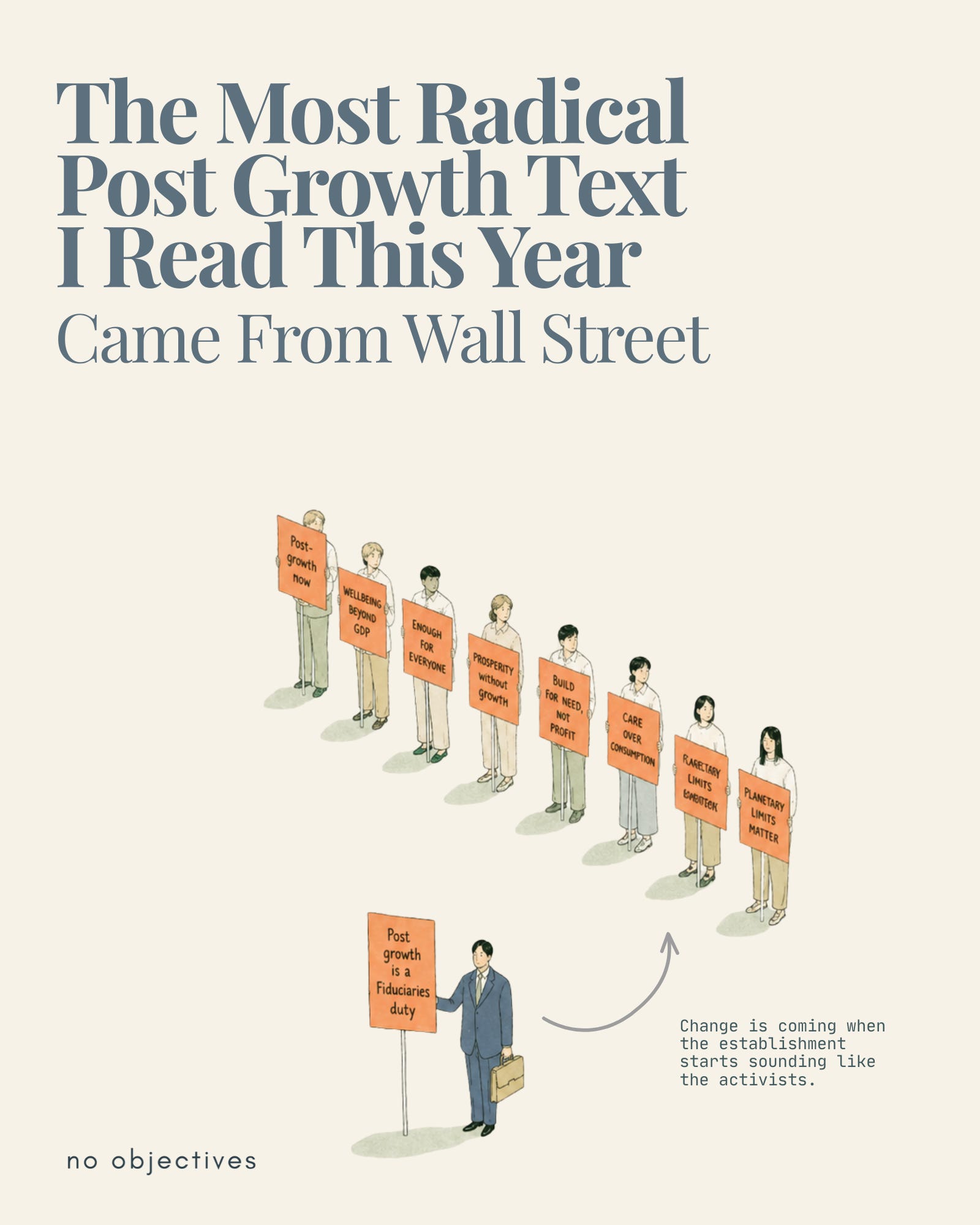
Why this really matters. I have spent years arguing that planetary boundaries are physical limits, not policy targets, and that economic models omitting them are misleading by omission. Those arguments usually live in academic journals and activist campaigns, and they usually get answered with the same word: unrealistic. What Brown has done is smuggle the entire argument into the operating system of wealth management. Limits to Growth data, overshoot, degrowth, the wellbeing economy, all of it translated into allocation percentages and drawdown rules, into the language of fiduciary duty, published in an industry journal with compliance disclosures at the bottom of the page. This is what it looks like when a minority insight starts becoming majority infrastructure. Not a protest outside the building. A framework inside it.
There is a lesson here for everyone working on systemic change. Ideas do not cross over when they get louder. They cross over when someone translates them into the native language of the institution that needs to hear them. For the building industry, that language is regulation and risk. For finance, it is fiduciary duty. Brown found the translation.
The growth story is ending either way. The data has been saying so for fifty years, and now the trendlines agree. The only open question is Herrington’s: design or disaster. When Wall Street’s own advisers start building portfolios for the end of growth, the design has begun. Because change is coming when the establishment starts sounding like the activists.
Read the original. It deserves it.
Link:
"There is a lesson here for everyone working on systemic change. Ideas do not cross over when they get louder. They cross over when someone translates them into the native language of the institution that needs to hear them."
Doesn't investing just perpetuate the whole thing we're trying to bring down?