
The Revolution Won’t Be Televised — It’ll Be Commodified

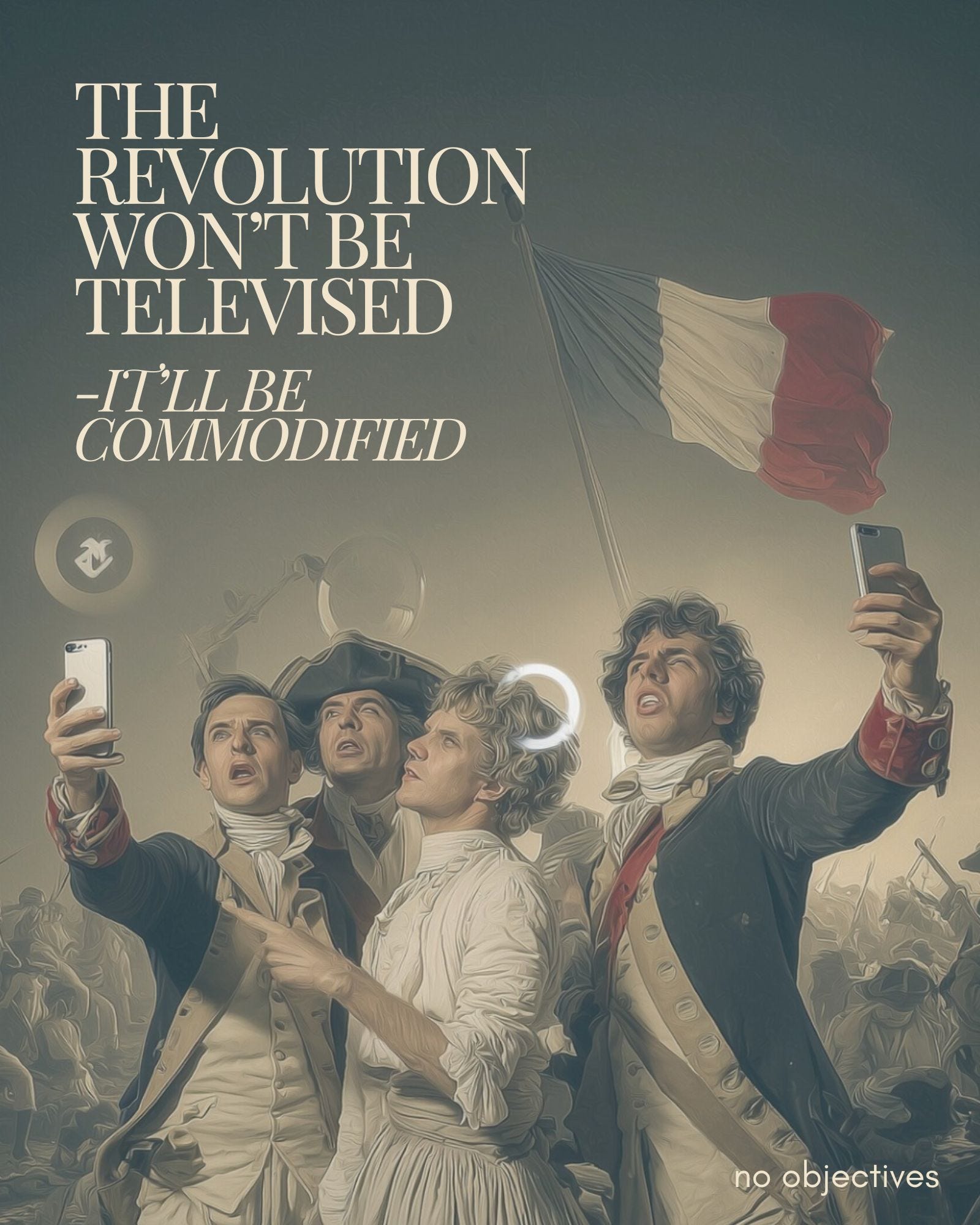
A few weeks ago, I came across a post by Louisa Toxværd Munch — a brilliant teacher who, with a few sharp sentences, managed to explain something both simple and profound. It went something like this:
“The revolution won’t be televised. It’ll be commodified. You’ll be able to buy the T-shirt.”
That line hit like a philosophical slap. It’s funny, unsettling, and a little too true. Because in a world where every act of rebellion can be turned into a brand, sold back to us, and worn as fashion — what does revolution even mean anymore?
Let’s rewind.
The Dream According to Marx
Karl Marx, the 19th-century thinker with the bushy beard and even bushier ideas, believed history was shaped not by noble ideals but by struggle. Specifically, class struggle — the eternal tug-of-war between the powerful and the powerless, the owners and the workers, the rich and the rest.
In Marx’s view, human progress was a sort of historical conveyor belt: feudalism would give way to capitalism, capitalism to revolution, that then finally it would enable communism — Marx’s faith in this process wasn’t based on optimism but inevitability. He thought suffering would be the great awakener. Once people realized how rigged the system was, they’d unite, overthrow their oppressors, and build something fairer.
A beautiful idea. Logical, even.
Except it didn’t quite happen.
Turns out feudalism did lead to capitalism. Capitalism led to “communism” in the USSR, , but what’s it led to now? Techno feudalism. It’s looped back on itself. The snake is eating its own tail.
Why the Revolution Never Came
One of Louisa’s students — let’s call him Finn — asked the kind of question that can deflate a century of theory in five words:
“So, why hasn’t the revolution happened yet?”
Indeed. If Marx was right, by now we should all be living in some post-capitalist utopia. Instead, the rich have private islands, and the rest of us have subscription services.
Capitalism didn’t die — it upgraded.
We got something far stranger: techno-feudalism. A world where billionaires are our new lords, our data is the new farmland, and we, the users, are the peasants endlessly producing digital labor for free.
We scroll, click, share, and like — feeding empires that grow richer the more we “connect.” The snake has eaten its own tail.
As cultural theorist Mark Fisher once wrote, “It’s easier to imagine the end of the world than the end of capitalism.”
That’s the real tragedy: it’s not that people don’t suffer — it’s that they can’t imagine anything different.
Capitalist Realism: The Cage You Can’t See
Mark Fisher called this condition capitalist realism — the sense that capitalism isn’t just the dominant system; it’s the only possible system. It’s the air we breathe. Even our dreams come branded.
Think about it:
You can buy “resistance” hoodies made in sweatshops.
Multinationals celebrate Pride Month — while funding anti-LGBTQ politicians.
Environmental destruction becomes an opportunity for “green investment portfolios.”
Capitalism doesn’t fight rebellion — it absorbs it, packages it, and sells it back to us at a markup.
And so, instead of rising up, we shop.
Marx believed suffering would spark class consciousness. But suffering alone doesn’t create awareness. It just hurts.
What’s missing is what Paulo Freire — the Brazilian educator and philosopher — called critical consciousness: the ability to name the world, to see systems of power, to understand the roots of injustice, not just its symptoms.
Without that awareness, suffering is just… noise.
Imagination Isn’t the Problem
This is where Louisa’s insight flips the old Marxist narrative on its head.
Marx believed people failed to revolt because they lacked consciousness — they didn’t see the system clearly enough. But Louisa says that’s not the real problem anymore. We see it. We meme it. We joke about late-stage capitalism every day.
According to Louisa, the real problem is imagination — that people can no longer imagine a different world, that we’ve become trapped inside capitalism’s mental boundaries. And she argues that rekindling that imaginative capacity is the first step toward change.
She’s right that something fundamental has been lost.
But I think she’s only half right.
Because to me, the issue isn’t imagination — it’s action.
We don’t suffer from a lack of vision; we suffer from a lack of agency.
We know what’s wrong. We even know what could be better. But techno-feudalism has dismantled the very foundations of collective power.
The spaces where we once gathered — unions, neighborhoods, civic groups, even shared lunch breaks — have been eroded by the culture of constant connectivity and private consumption.
Instead of collective power, we have individualized performance.
Instead of solidarity, we have self-branding.
Instead of movements, we have moments.
The Crisis of Action
And that’s precisely how the system sustains itself.
When every social problem is reframed as a personal failing — burnout, debt, insecurity, anxiety — we don’t fight back; we self-optimize.
We buy courses on mindfulness instead of demanding shorter workweeks.
We install apps to track our “well-being” while our rent doubles.
We post about injustice to show we care — and then go back to work, tired, overdrawn, but feeling slightly better for having done something.
Capitalism has learned the greatest trick of all: how to turn even resistance into revenue.
So yes, we still dream of a better future. We just can’t find the time, space, or community to make it happen.
From Critical Thinking to Collective Action
Here’s where Louisa and I converge again. We both believe that awareness alone isn’t enough. People need tools — a way to understand and name what’s happening to them.
In the 20th century, thinkers like Antonio Gramsci, Paulo Freire, and bell hooks taught us that education is the first step toward liberation. Freire called it critical consciousness — learning to name the world, to understand how systems of power operate.
But today, we’ve mistaken awareness for understanding. A viral infographic isn’t consciousness. A podcast isn’t praxis.
Critical thinking — the ability to trace cause and effect, to question narratives, to recognize manipulation — is the oxygen revolutions run on. Without it, imagination floats away like smoke.
But even critical thinking is only half the story. We also need critical spaces — places where people can gather, speak, and act together in ways that break the spell of individualism.
Because revolutions don’t happen in solitude. They happen in solidarity.
We need to start rebuilding the places where collective action for systemic change is possible — places where we regain social connection, reclaim our agency, and step out of the accelerometer.
We’ve built a society where acceleration feels inevitable — where productivity, performance, and progress run faster than our capacity to live. The result is a civilization gasping for breath, constantly moving but rarely changing.
The antidote isn’t another app. It’s air.
The air that comes from slowing down, meeting face to face, rediscovering the power of we.
Reclaiming the Commons of Action
Think about what has always driven real change: shared places.
The coffeehouses of the Enlightenment. The union halls of the labor movement. The churches and buses of the civil-rights era.
Every revolution in history began not with ideas, but with spaces — physical or social — where people came together to imagine and act as a collective force.
Today, our commons are privatized, our public spaces commercialized, our online spaces monetized. Even protest has to compete with the algorithm.
To restart the engine of change, we have to rebuild these commons — not as nostalgic relics but as laboratories for a livable future.
It could be a community center, a climate collective, a cooperative kitchen, a library that hosts local assemblies. It could be anywhere people can organize beyond the metrics of engagement and the logic of profit.
These spaces are where imagination meets practice — where “what if” becomes “what now.”
Hope, Imagination, and the Missing Step
Louisa says imagination is the spark we’ve lost — and she’s right that it’s a spark. But sparks alone don’t light fires.
Hope, today, isn’t naïve — it’s necessary. But hope without structure, imagination without practice, quickly burns out.
To hope, to gather, to care for one another in public — these are indeed revolutionary acts in an economy that profits from despair and distraction.
But the step that turns these acts into transformation is critical action: thinking clearly enough to understand the system, and standing close enough to others to do something about it.
Because belief doesn’t precede action - it emerges from it.
So yes, Marx was wrong about suffering automatically leading to revolution.
And maybe Mark Fisher was wrong that there’s no outside to capitalism.
Because the “outside” might not be a place at all — it might be a practice: the daily, stubborn act of questioning, organizing, and rebuilding what the system has dismantled — trust, connection, courage.
The Call to Collective Action for systemic changez
So where does that leave us?
With a simple truth that’s both humbling and empowering:
The revolution won’t come from suffering alone, or imagination alone.
It will come from critical, collective action grounded in shared understanding.
That means finding and nurturing the spaces — physical, social, emotional — where we can breathe again. Where we can stop running on the hamster wheel and start walking toward something real.
The future won’t be sold to us. It will be built by us — in moments of togetherness that can’t be monetized.
So the next time you see a T-shirt that says “The Revolution Will Not Be Televised,” remember Louisa’s twist:
The revolution won’t be televised — it’ll be commodified.
Unless, of course, we take it back —
not just in imagination,
but in action.
https://transitionnetwork.org/
Thank you so much for your reflection. Me and my boyfriend are trying to join or create a community exactly as you describe. Just reading about how the world works makes us feel frustrated because it feels like there’s no way out. We need each other to transform that frustration in something positive. To be part of something else than “this” way of living.