

A dollar swap line sounds technical, almost boring but to understand this story its important you know what it means. In simple terms, it is an agreement between two central banks that allows one country to access U.S. dollars in times of stress. The Federal Reserve provides dollars to another central bank. That central bank then lends the dollars into its own financial system, helping banks, companies, or markets that suddenly need dollar liquidity.
Why does that matter?
Because the dollar is not just America’s currency. It is the operating system of the global economy. Oil, debt, trade, reserves, sanctions, shipping, insurance, and financial markets all depend heavily on access to dollars. When that access becomes uncertain, countries can face pressure even if they are not technically broke. So a dollar swap line is not just financial plumbing. It is a signal. It says: you are inside the protected zone of the dollar system.
And that is why the recent discussions between the U.S., the UAE, and other Gulf and Asian partners are so revealing. On the surface, this looks like a small technical measure to calm markets during Middle East instability. But underneath, it raises a much bigger question. Why would the U.S. offer a dollar backstop to countries that already have enormous reserves, vast sovereign wealth, and deep ties to the dollar system? That is where the story begins.
The strange thing about the proposed U.S. dollar swap line with the UAE is not that it exists.The strange thing is that it is so small. Not small in the ordinary sense. Twenty billion dollars is still a number large enough to make normal people feel like they have accidentally opened the wrong spreadsheet. But in the context of Gulf sovereign wealth, U.S. investment pledges, oil shocks, AI infrastructure, and the wider architecture of dollar power, it is almost comically modest. This is not a fire truck arriving at a burning city. It is a man in a tuxedo calmly carrying a glass of water toward a volcano. And that is exactly why it matters. Reuters reported that U.S. Treasury Secretary Scott Bessent said Gulf and Asian allies had requested dollar swap lines to deal with energy shocks and wider fallout from the Middle East war. His stated rationale was revealing: the swaps would help maintain order in dollar funding markets and prevent disorderly sales of U.S. assets.
That sentence is the whole story hiding in plain sight. The official story is stability. The deeper story is dependency. The swap line is not really about saving the UAE. The UAE is not Argentina. It is not standing outside the IMF with a cardboard sign saying “will reform for dollars.” It is one of the most financially resilient states on earth. It has vast reserves, enormous sovereign wealth, and a long-standing dollar peg. notes that the UAE held around $285 billion in foreign reserves at the end of 2025 and had dollar assets exceeding dollar liabilities by roughly $1 trillion. So why does a country that does not obviously need a rescue ask for a lifeline?
Because this is not about solvency. It is about the performance of confidence. A dollar swap line is, in technical terms, a liquidity arrangement. The Federal Reserve describes these facilities as tools that allow foreign central banks to access dollars and distribute them into their own financial systems during stress. The foreign central bank takes the credit risk. The Fed gets its dollars back under the agreed terms. But in geopolitical terms, a swap line is something else. It is a velvet rope. It marks who is inside the dollar club and who is outside it. It says: you are not just a customer of the dollar system. You are protected by it. That is why the smallness is not a weakness in the argument. It is the argument. The point is not to compensate the Gulf for trillions in threatened investment. The point is to send a signal large enough for markets, but small enough to avoid panic. Too large, and it looks like a bailout. Too small, and it looks absurd. The genius, or the comedy, is that it manages to be both. The U.S. is not trying to reimburse Gulf capital for the damage caused by war. It is trying to stop Gulf capital from doing the one thing Washington cannot afford: disorderly withdrawal.
That is why Bessent’s language matters. He did not say the UAE needed dollars because it was broke. He said swap lines prevent disorderly sales of U.S. assets. Translation: please do not sell the furniture while the house is shaking. This connects directly to the larger thesis running through my previous essay on Venezuela and Iran. The Venezuela essay argues that the real threat was not simply oil, but a working example of energy trade and state survival outside the dollar system. It points to China’s November 2025 dollar bond issuance in Hong Kong, where a $4 billion deal reportedly attracted enormous demand, as a symbolic rupture in the old financial hierarchy.
The Iran essays make a parallel argument: that war arrives when diplomacy begins to threaten deeper structures of power. “Bombs Over Diplomacy” frames the Iran war as something that cannot be understood only through nuclear security, because the timing, beneficiaries, and financial context point toward a wider struggle over global order. Seen through that lens, the UAE swap line is not separate from Iran and Venezuela. It is the other side of the same machine. Venezuela is what happens when a state proves it can function outside the dollar system. Iran is what happens when a regional power cannot be folded back into the U.S.-led order without force.
The UAE is what happens when a loyal dollar-aligned state starts to discover that loyalty does not protect it from the consequences of U.S. war. So Washington reaches for the imperial toolkit. Bombs for the defectors. Swap lines for the friends. Sanctions for those who leave. Liquidity for those who stay. This is why the optics are so dangerous. The swap line is supposed to say: the dollar system is strong enough to protect its allies. But it can also be read the other way: the dollar system is now so fragile that it has to visibly reassure countries that are already solvent. That is not confidence. That is confidence cosplay. And markets are very good at spotting cosplay.
The U.S. still has enormous power. Nobody serious should pretend otherwise. The dollar remains central to global trade, finance, debt, reserves, energy, and sanctions. The Federal Reserve’s existing swap lines were critical during the global financial crisis and COVID-era dollar shortages, and CFR describes Fed swaps as among the most important cross-border policy responses to those crises. But the problem is not that the dollar is dead.The problem is that the dollar now has to keep proving it is alive. That is a different phase of empire. China is openly trying to deepen yuan bond markets in Hong Kong and accelerate the international use of its currency. Reuters reported that Chinese officials have framed this work in the context of rising geopolitical tension and a more multipolar monetary system.
Meanwhile, Gulf capital has become central to the U.S. growth story. Reuters reported that Abu Dhabi pledged $1.4 trillion in U.S. investments, Qatar planned $500 billion, and Saudi Arabia discussed commitments rising from $600 billion toward $1 trillion. This is the absurdity: the U.S. does not merely project power into the Gulf. It increasingly depends on Gulf capital to finance its own industrial, technological, and military future.
So when the Iran war destabilizes the Gulf, the U.S. is not just risking oil flows. It is risking the balance sheet of its own future. That is why the swap is small. Because the real thing being protected is too large to name. The swap is not the rescue package. The swap is the symbolic seal on a much bigger bargain: keep your money in our system, keep your reserves in our assets, keep your oil and infrastructure tied to our currency, and we will provide the appearance of unlimited backing. But the appearance is the product..
The swap line is meant to create the illusion of a strong dollar order. But by extending that reassurance to a country with massive reserves and huge sovereign wealth, it accidentally reveals the opposite: the dollar order is no longer self-evident. It must now be staged, defended, dramatized, and occasionally subsidized. A truly confident hegemon does not need to remind everyone where the exits are. A nervous hegemon installs better lighting around the doors. So the small swap is not small because the problem is small. It is small because the problem is enormous. A large swap would admit panic. No swap would risk defection. A small swap does the only thing left: it performs control.
That is the deeper geopolitical function. It is a financial loyalty ritual disguised as a liquidity tool. It tells Gulf states: you are still inside the protected zone. It tells markets: do not front-run a Gulf selloff. It tells China: the dollar network still has privileges you cannot yet match. It tells domestic audiences: this is not a bailout, just plumbing. But plumbing is politics when the whole empire runs on pipes.
And this is where the story becomes almost funny, in the darkest possible way.For years, Washington told the world that dollar dominance was natural. Efficient. Neutral. The logical outcome of trust in American institutions. Now it is offering emergency access to dollars to rich allies so they do not have to sell American assets too quickly because a U.S.-backed war has destabilized the region that finances the U.S. economy. That is not a system demonstrating strength. That is a system whispering: please don’t make this weird. The swap line is small because it is not a solution. It is a sedative.It is there to calm the patient, not cure the disease.
The disease is that the U.S. wants to remain the center of the global financial system while behaving in ways that make the rest of the world search for exits. Venezuela, Iran, China, and now the Gulf are not separate stories. They are different chapters in the same story: the slow politicization of the dollar system by the very power that depends on everyone pretending it is neutral. That is the trap. The more the U.S. weaponizes the dollar, the more others seek alternatives. The more others seek alternatives, the more the U.S. must weaponize, subsidize, or theatrically defend the dollar.At some point, the empire is no longer maintaining confidence. It is maintaining the performance of confidence. And that is why this tiny swap matters. Not because it saves the UAE. It does not. The UAE is not the patient on the operating table. Wall Street is. The U.S. economy is.
The swap line is not really a bailout of the Emirates. It is a bailout of the system that needs Emirati money to stay where it is. It is a bailout of U.S. asset markets. A bailout of Treasury markets. A bailout of the illusion that the dollar order is still so strong that no one would ever think of leaving. But that is exactly what makes it so revealing. Because when someone suddenly starts bringing roses after five years of never doing so, the roses are not proof of love. They are evidence that something has gone wrong. The gesture is small.That is what makes it suspicious. A small gift can reveal a large betrayal. A small swap can reveal a large rupture. The U.S. is not offering twenty billion dollars because the UAE is collapsing. It is offering twenty billion dollars because Washington can see the crack forming beneath its own feet.
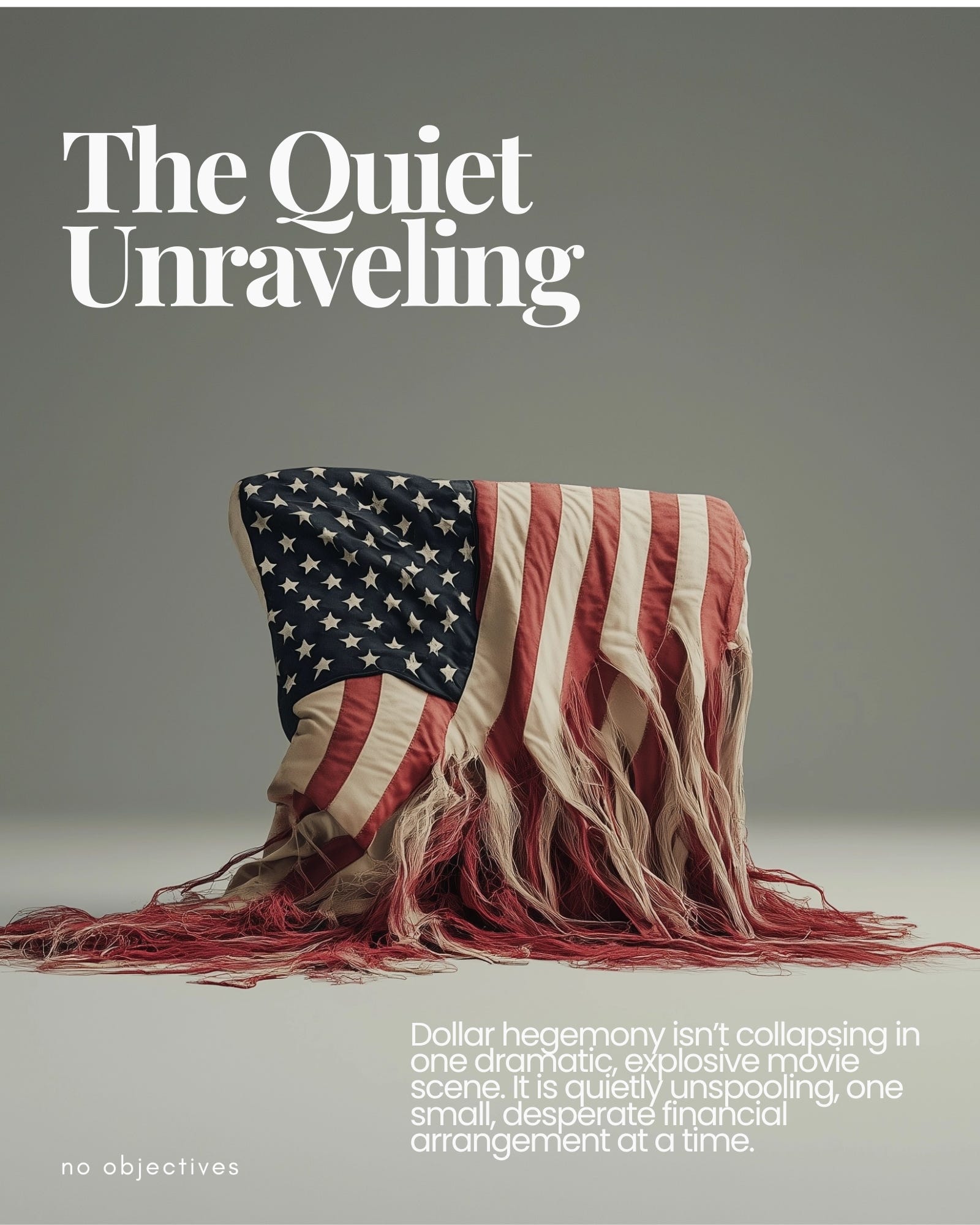
The point is not the size of the swap. The point is that the swap has to exist at all. A truly confident hegemon does not need to reassure loyal allies that the system still works. A nervous hegemon does. It sends flowers. It sends liquidity. It smiles too much. It says: everything is fine.And that is when everyone starts looking at the exits. This is not collapse tomorrow. It is not dedollarization overnight. It is not one dramatic end-of-empire movie scene with falling flags and violin music. It is something more dangerous. A slow realization among allies that the dollar system is no longer a neutral shelter. It is a geopolitical contract. And like all contracts, it can be renegotiated. That is the real rupture. Not that the UAE needs rescuing. But that the U.S. now has to rescue itself by pretending to rescue the UAE. The swap is small because Washington is not buying stability. It is buying silence. It is buying loyalty. It is buying time.
The small swap is a que that the extinction burst of dollar hegemony is coming.
Sources
Reuters. “US discussing dollar swap lines with Gulf and Asian partners, Treasury’s Bessent says.” April 24, 2026. Used for Bessent’s comments on Gulf and Asian allies requesting swap lines, the Iran war fallout, dollar liquidity, new dollar funding centers, and the fact that many of these countries have strong balance sheets and large dollar holdings. US discussing dollar swap lines with Gulf and Asian partners, Treasury’s Bessent says | Reuters
Federal Reserve Board. “Central bank liquidity swaps.” Used for the technical explanation of how dollar liquidity swap lines work, including foreign central banks distributing dollar funding during market stress, repayment mechanics, maturities, and credit risk. Federal Reserve Board - Central bank liquidity swaps
Council on Foreign Relations. “Central Bank Currency Swaps Tracker.” Used for the broader historical context of central bank swaps from the global financial crisis through COVID-19 and into the present. Central Bank Currency Swaps Tracker | Council on Foreign Relations
Responsible Statecraft. “UAE’s dollar swap threats show how brittle these US alliances can be.” Used for the claim that UAE officials reportedly warned they may need yuan or other currencies if dollar access became strained during the Iran war. UAE’s dollar swap threats show how brittle these US alliances can be | Responsible Statecraft
The Minority Report Publication. “The Real Reason Why the US Overthrew Venezuela.” January 4, 2026. Used for the essay’s underlying thesis that Venezuela is tied to the struggle over the dollar’s role as the world’s dominant reserve currency. (13) The Real Reason Why the US Overthrew Venezuela
The Minority Report Publication. “Bombs Over Diplomacy.” March 2026. Used for the Iran framing that the war should be understood beyond narrow nuclear-security explanations and within a wider struggle over hegemony and global order. (13) Bombs Over Diplomacy - The Minority Report Publication
The Minority Report Publication. “Why the US Will Lose to Iran.” March 10, 2026. Used for the Iran-war analysis and the game-theory framing of the conflict as part of a wider breakdown in the global order. (13) Why the US Will Lose to Iran
Reuters. “China eyes $4 billion dollar bond, term sheet shows, orders top $65 billion.” November 5, 2025. Used for China’s $4 billion dollar bond issuance in Hong Kong and the reported scale of investor demand.China eyes $4 billion dollar bond, term sheet shows, orders top $65 billion | Reuters
Financial Times. “China borrows as cheaply as US in dollar bond market.” November 2025. Used for the point that China’s dollar bonds were priced at borrowing costs comparable to U.S. Treasuries, a key part of the “symbolic rupture” argument. China borrows as cheaply as US in dollar bond market
Reuters. “UAE commits to $1.4 trillion US investment, White House says.” March 21, 2025. Used for the UAE’s 10-year, $1.4 trillion U.S. investment framework in AI infrastructure, semiconductors, energy, and manufacturing. UAE commits to $1.4 trillion US investment, White House says | Reuters
Reuters. “Trump wraps up Gulf tour with AI and energy deals in UAE.” May 16, 2025. Used for the UAE’s role in U.S. AI, energy, and manufacturing investment strategy, including advanced AI semiconductor access and energy-investment commitments.Trump wraps up Gulf tour with AI and energy deals in UAE | Reuters
Reuters. “Qatar’s QIA plans to at least double annual US investments over next decade.” May 20, 2025. Used for Qatar’s $500 billion U.S. investment pledge and wider Gulf investment commitments. Trump wraps up Gulf tour with AI and energy deals in UAE | Reuters
Associated Press. “Saudi Arabia floats $600 billion investment in US.” January 2025. Used for Saudi Arabia’s stated intention to invest $600 billion in the United States, with potential expansion beyond that figure. Saudi Arabia floats $600 billion investment in US | AP News