
We Are All on Apollo 13
Why limits are the most creative force we have left

This is part 1 of a 4-part summer series on why the world resists the change it needs, and what would actually deliver it. Four essays, one argument: limits are the answer, the system refuses them, only organized power can impose them, and that power is already in us.
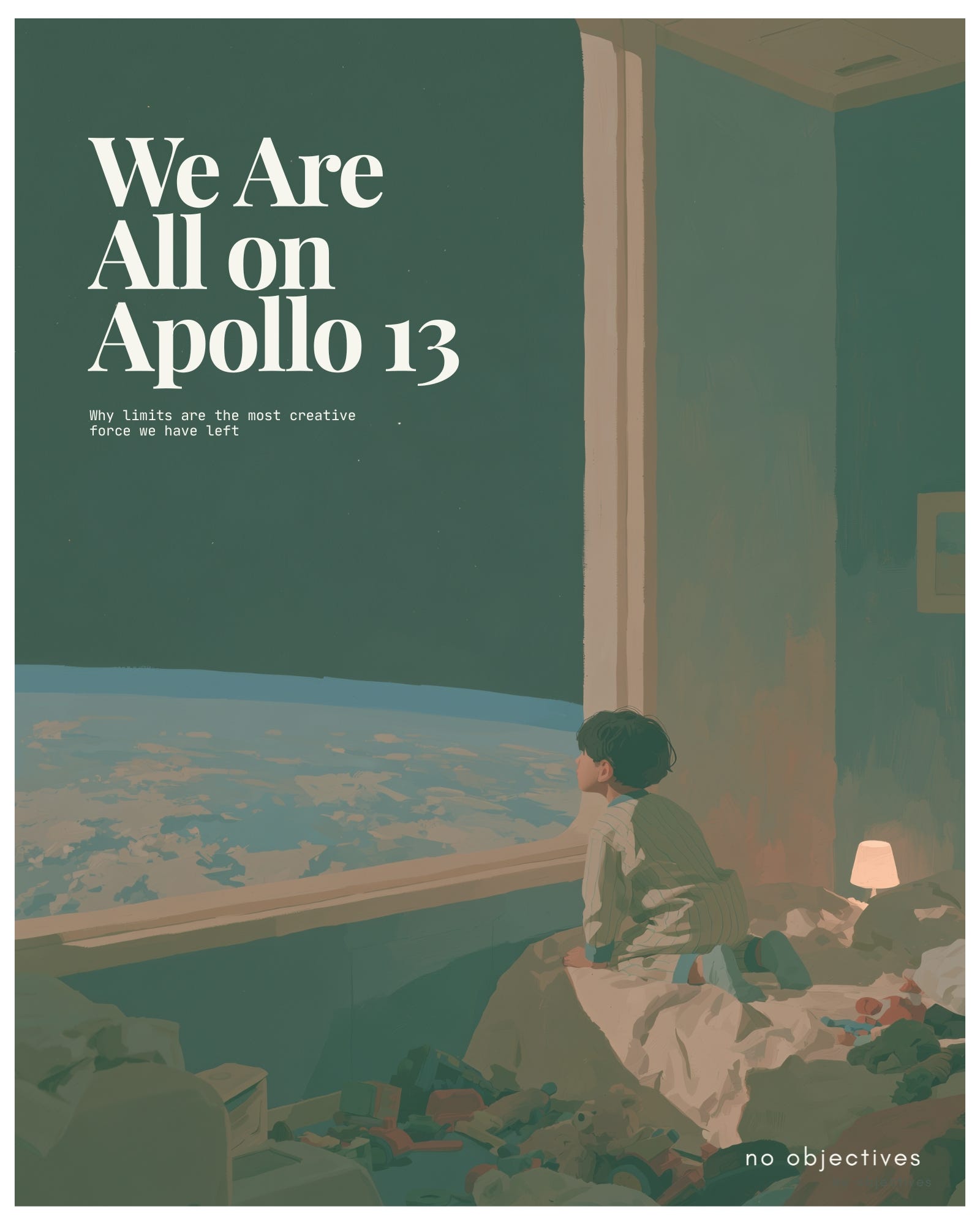
Here is an uncomfortable thought to start your week. The freedom we have spent a century chasing might be the very thing making us anxious, dull, and, at the largest scale, self-destructive.
Watch it operate on a small scale first. You open the streaming app and scroll for forty minutes without watching a thing. In the cereal aisle, thirty near-identical boxes trigger a flicker of despair you would be embarrassed to admit out loud. And when you sit down to write, or paint, or start a company, the blank openness of it swallows you whole. We call this freedom. If we were honest, we would call it paralysis.
The science journalist David Epstein has built a whole book around that discomfort. His claim sounds backwards until it doesn’t. What overwhelms us is not a shortage of options. It is a flood of them, with no banks to keep the river moving in any direction. Now watch what a limit does. In 1960, Dr. Seuss’s publisher bet him he could not write a book using fifty distinct words. Fifty. Seuss took the bet, wrote Green Eggs and Ham, and produced one of the best-selling children’s books in history. Strip a genius of his vocabulary and he does not fall silent. He goes and finds a music he would never have thought to look for.
The pattern gets almost suspicious once you start noticing it. Bach treated the rigid architecture of the fugue like a jungle gym and wrote some of the most inventive music ever committed to paper. Duke Ellington shaped his sound around the three-minute ceiling of early records, turning a technical annoyance into a signature. Georges Perec wrote an entire novel without once using the letter e, the most common letter in French, and the missing letter dragged him into a strange new vocabulary he would otherwise never have touched. The periodic table, one of the most elegant ideas in all of science, snapped into place partly because Dmitri Mendeleev was racing a textbook deadline.
And then there is Apollo 13, which we are going to come back to, because it turns out to be the whole argument in miniature. Two hundred thousand miles from Earth, the ship crippled and the cabin air turning poisonous, engineers on the ground had to build a filter to scrub carbon dioxide out of the capsule. They could use only what was already on board. A plastic bag, a sock, the cover of a flight manual, some tape. They built it. The crew came home. Not despite the brutal limit on materials, but because of it. A warehouse of options would have killed those men. The constraint is the thing that saved them.
This is not a scrapbook of charming anecdotes. In 2019, three researchers went through 145 separate studies on constraints and creativity and found a clean, slightly embarrassing pattern. Creativity climbs with constraint, up to a point, then drops if you overdo it. An inverted U. Too few limits and people coast on the first obvious idea. Too many and they suffocate. The sweet spot, the place where humans actually get interesting, sits in the middle, inside a fence.
You can watch the same law wreck a company. In the 1990s, a startup called General Magic gathered some of the most gifted engineers alive, poured in money, and handed them near-total freedom to invent the future. They more or less designed the smartphone a decade early. Then they fell apart, undone by having too much room and too little focus. Down the road, Pixar chained itself to strict rules of story structure and became, well, Pixar. Same era, same talent pool, opposite ending. The difference had nothing to do with brains or budget and everything to do with the presence of a good fence.
Why does the fence work? Because it kills the obvious answer, and killing the obvious answer is the only thing that reliably drags a better one out of you. Hand your brain an open field and it wanders straight to the nearest cliché. Take the easy path away and it has to go rummaging in the corners it would normally skip. Constraints also turn work into a game, and games are the most engaging thing our species has ever built. Nobody loves chess, football, or Wordle in spite of the rules. The rules are the fun. Delete them and you do not get a freer, better game. You get a few confused people standing on a field with a ball and no reason to move.
Erich Fromm saw the dark version of this in the 1930s. Watching whole societies buckle, he noticed that people handed total, structureless freedom often panic and bolt from it, sometimes straight into the arms of whoever promises order, however ugly the order turns out to be. His lesson was not that freedom is bad. Freedom without form is simply unbearable, and choosing your own limits is one of the most human acts there is. Discipline is not the opposite of freedom. It is how you manufacture it.
So why is choosing our own fences so hard? Epstein points straight at the answer, and it is older than any of us. For almost the entire span of human existence, we lived in scarcity. The next meal was never guaranteed, winter was always coming, and the group with a little more was the group that made it through. In that world, wanting more was not greed. It was arithmetic. The brain that grabbed the extra calories and hoarded the spare resource is the brain that lived long enough to become your ancestor. Every one of us is running on software written for famine. And now we find ourselves in the most abundant, option-flooded moment in the history of the species, with that ancient code still shouting its single instruction into all the noise. More. More. More.
The biologist E.O. Wilson compressed the whole predicament into one sentence.
“The real problem of humanity is the following: We have Paleolithic emotions, medieval institutions and godlike technology.”
Sit with that for a second. Our appetites come straight off the savanna. Our institutions are slow, rigid, and half-broken. And the power now sitting in our hands is the kind we once reserved for gods. A cave-brain that wants everything, wired directly into an economy that can strip a planet bare. What could possibly go wrong.
Here is what went wrong. The largest machine we have ever built, the global economy, runs on the exact fantasy Epstein spends a book dismantling. More is always better. Growth should never stop. There is no fence, and there should not be one. We took a Paleolithic craving, hard-coded it into policy, and congratulated ourselves for it, as if boundlessness were the same thing as ambition.
We have, in other words, built General Magic at the scale of a planet. Unlimited money, dazzling inventions, and no adult in the room asking what any of it is actually for. And like General Magic, the thing is beginning to come apart from sheer lack of focus. The climate is destabilizing. The living web of species is thinning out. A strange civilizational tiredness has settled over everything, the species-level version of scrolling for forty minutes and watching nothing. Which is where Apollo 13 stops being a feel-good story and turns into a mirror. We are the crew. Earth is the module. There is no resupply mission, no fresh planet pulling up alongside with a fresh tank of air and a crate of spare metal. Whatever we build from here, we build out of what is already on board. That is not a motivational poster, it is the plain physics of a closed system, and we have spent two centuries acting as though the walls simply were not there.
A sufficiency economy is nothing more exotic than the decision to admit the walls exist and start designing inside them. It opens with the one question a growth economy is constitutionally incapable of asking. How much is actually enough? Enough energy, enough material, enough space for a good and dignified life. Sufficiency comes first, ahead of efficiency, ahead of the scramble for cleaner supply, because it is the constraint that reorders everything downstream of it.
And if Epstein is right, if the blank page paralyzes and the fence sets us free, then this is not the grim story of sacrifice we keep getting sold. It is the most creatively fertile move left on the table. A carbon budget is just a word count. It is Seuss being handed fifty words instead of the whole dictionary and writing the book children memorize rather than the one they forget. Told we cannot simply pour our way out of a housing crisis with endless new concrete, we would finally look hard at the tens of millions of people who could live inside Europe’s existing buildings without a single new foundation. We would repair instead of replace, renovate instead of demolish, and share what already stands instead of hoarding the right to build more. The limit sharpens the imagination rather than shrinking it, exactly as it did for a crippled spacecraft and a fifty-word book.
We keep flinching at limits as though they were losses, as though every fence were a cage. It is the same reflex that makes the blank page look like freedom right up to the moment it defeats us. But that low hum of overwhelm so many of us carry, the feeling of a world spinning faster and faster with no shape to it, has nothing to do with having too few choices. It is what a system with no fence feels like from the inside. We did not run out of ideas,we ran out of fence. Draw the line at enough, and watch the panic lift, the problem turn solvable, and the creativity we were told we could not afford turn out to be the one resource that was never scarce in the first place. So Give me a fence, and I will show you a field worth working.
Sources
David Epstein, Inside the Box: How Constraints Make Us Better (Avid Reader Press / Penguin Random House, 2026).
Oguz A. Acar, Murat Tarakci and Daan van Knippenberg, “Creativity and Innovation Under Constraints: A Cross-Disciplinary Integrative Review,” Journal of Management 45, no. 1 (2019): 96–121. The review of 145 studies. Its core finding is an inverted-U: moderate constraints help, while too few and too many both hurt. https://doi.org/10.1177/0149206318805832
“The Creativity of Constraint: Why Limits Spark Innovation,” ThoughtLab. Source for the Apollo 13 carbon dioxide filter and Georges Perec’s e-less novel La Disparition. https://www.thoughtlab.com/blog/the-creativity-of-constraint-why-limits-spark-inno/
Edward O. Wilson, “We have Paleolithic emotions, medieval institutions and godlike technology.” The line comes from a 2009 debate at Harvard University and recurs across his later writing. Source for the mismatch between our ancient appetites and our modern power.
BPIE, VELUX, RISE and Artelia, The Housing We Need for the Future We Want (Green Paper). Source for the figure that Europe’s existing building stock could house tens of millions more people without new construction.
https://livingplaces.velux.com/en/experiments/reliving
Brilliant post. Nailed it.
I have worked, for most of my life, in IT, and we have a term for this exact problem: "Analysis Paralysis". A failure to get things done, (actually, even started), because simple parameters, (like: what do we actually need; what's our budget), are not set.
And... when are people going to understand, we live on a planet of finite resources?
Wow. What a brilliant piece of writing. Please fence me in.